The Battle June 5, 1942
- Japanese commander Yamamoto cancels Midway invasion.
 Yamamoto held several important posts in the Imperial Japanese Navy, and undertook many of its changes and reorganizations, especially its development of naval aviation. He was the commander-in-chief during the decisive early years of the Pacific War and was so responsible for major battles such as Pearl Harbor and Midway. He died during an inspection tour of forward positions in the Solomon Islands when his transport aircraft was ambushed by American P-38 Lightning fighter planes. His death was a major blow to Japanese military morale during World War II.
- The two Japanese carriers hit on June 4 that did not sink were scuttled by the Japanese surface ships.
- PBY Catalina aircraft search the area of the battle and pick up survivors. Ensign George Gay rescued after staying in the water 36 hours.
 Ensign (later Lieutenant Commander) George H. Gay Jr. (March 8, 1917 in Waco, Texas - October 21, 1994) was a TBD Devastator pilot in United States Navy Torpedo Squadron 8 operating from the USS Hornet (CV-8) in the Pacific Theater of Operations during the crucial battle of Midway in World War II.
In the Battle of Midway, his unit found the main Japanese fleet and launched a suicidal attack unescorted by fighter planes. Of the squadron's thirty pilots and radiomen, Gay was the only survivor. His plane was shot down and, while floating in the ocean, he witnessed the subsequent dive bombing attacks that sank three of the four Japanese aircraft carriers present. After being rescued by a Navy PBY, he met with Admiral Nimitz and confirmed the destruction of the three carriers. - All available aircraft from Midway, Enterprise and Hornet searched for Japanese ships still in the area. "It's like shooting ducks in a barrel," responds one pilot because the Japanese ships had no aircraft protection.
- Carrier Hiryu burning before it sinks.
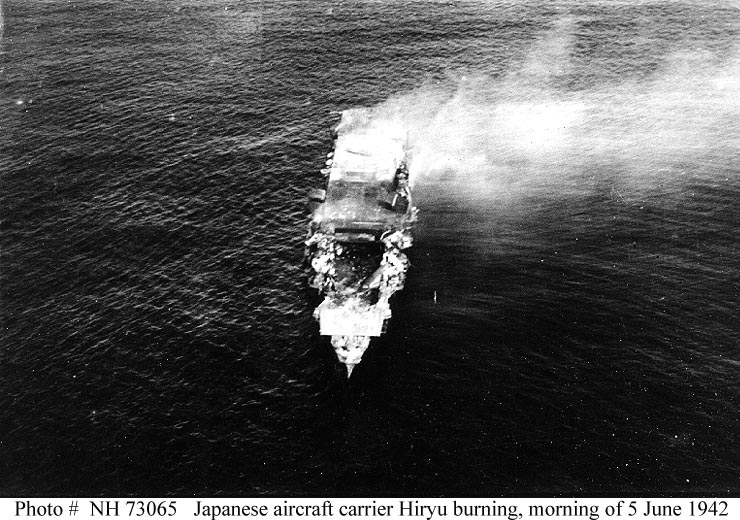 Hiryu Burning After The American Attack
 - Salvage efforts begin on the Yorktown.