The Battle Begins In A Few Hours
Los Angeles To Midway To Hawaii To Los Angeles In 21 Days
June 3, 1942; The Battle Is Hours Away
- On 3 June, in the preliminary moves of the Battle of Midway, American land-based aircraft from Midway located and attacked Japanese transports about 600 miles west of Midway Island. U.S. Army Air Force Boeing B-17 ("Flying Fortress") bombers inflicted no damage, however, and four Consolidated PBY ("Catalina's") from VP-24 were sent out for a night attack on the approaching transports. As part of the overall Japanese plan, the Second Strike Force (Rear Admiral Kakuta Kikuji) bombed Dutch Harbor with planes from light carriers Ryujo and Junyo. In an event whose importance became clear only later, one Mitsubishi A6M ("Zeke") carrier fighter was disabled by antiaircraft fire and made an emergency landing on Akutan Island. The pilot, fooled by the flat ground, flipped the plane over upon landing in a bog and was killed. American intelligence analysts later studied the plane to discover its strengths and weaknesses.
- The Japanese diversionary attack of the Aleutian Islands occurs.
The Aleutian Islands (possibly from Chukchi aliat, "island") are a chain of more than 300 small volcanic islands forming an island arc in the Northern Pacific Ocean, occupying an area of 6,821 sq mi (17,666 km²) and extending about 1,200 mi (1,900 km) westward from the Alaska Peninsula toward the Kamchatka Peninsula. Crossing longitude 180°, they are the westernmost part of the United States (and technically also the easternmost.
- PBY Catalina locates Japanese Midway Occupational Force coming from the southwest.
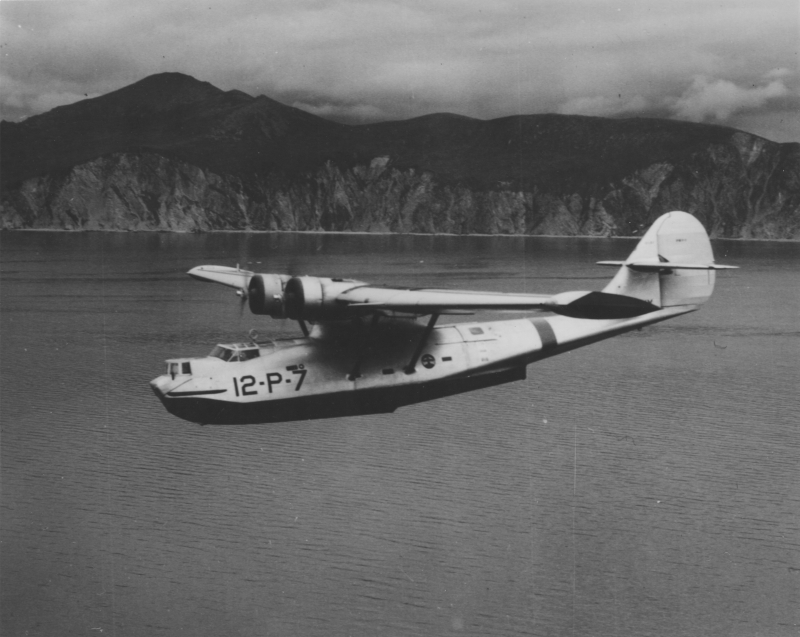
- PBY Catalina was the United States Navy designation for an American and Canadian-built flying boat of the 1930s and 1940s. PB stands for Patrol Bomber, with Y being Consolidated Aircraft’s manufacturer identification. It could be equipped with depth charges, bombs, torpedoes, and .50 caliber machine guns and was one of the most widely used multi-role aircraft of World War II. Catalina's served with every branch of the US military and in the air forces and navies of many other nations. In the United States Army Air Forces and later in the USAF Strategic Air Command their designation was the OA-10 while Canadian-built PBYs were known by the nickname Canso.
- Midway-based Flying Fortress B-17s try to bomb the landing force, no hits.
 The Boeing B-17 Flying Fortress is an American four-engine heavy bomber aircraft developed for the US Army Air Corps (USAAC).
Competing against Douglas and Martin for a contract to build 200 planes, the Boeing entry outperformed both the other competitors and more than met the Air Corps' expectations.
Although Boeing lost the contract due to the prototype's crash, the Air Corps was so impressed with Boeing's design that they ordered 13 B-17s. The B-17 Flying Fortress went on to enter full-scale production and was considered the first truly mass-produced large aircraft, eventually evolving through numerous design advancements, from B-17A to G.
-
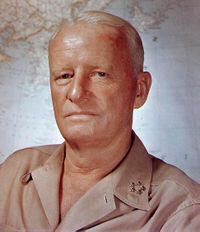 Nimitz clarifies that the observed force is not the main body and states the main body (the Japanese carriers) will come from the northwest on June 4th, 1942.
-
Chester W. Nimitz, a
German Texan
, was the son of Chester Bernhard and Anna (Henke) Nimitz. He was born in
Fredericksburg, Texas
, where his house is now a museum. His father died before he was born.
He was significantly influenced by his grandfather, Charles N. Nimitz, a former seaman in the German Merchant Marine, who taught him, "the sea - like life itself - is a stern taskmaster.
The best way to get along with either is to learn all you can, then do your best and don't worry - especially about things over which you have no control."
- Admiral Nimitz had one priceless asset: U.S. cryptanalysts had broken the
JN-25 naval code
. Commander Joseph Rochefort and his team at HYPO were able not only to confirm Midway was the target of the impending Japanese strike, but to provide Nimitz with a complete IJN order of battle. (Japan's efforts to introduce a new codebook were delayed, giving HYPO crucial days; they were blacked out shortly before the attack began. As a result, the Americans entered the battle with a very good picture of where, when, and in what strength the Japanese would appear.
Nimitz was aware, for example, the vast numerical superiority of the Japanese fleet had been divided into no less than
four task forces
, and the escort for the main Carrier Striking Force was limited to just a few fast ships.
For this reason, they knew the anti-aircraft guns protecting the carriers would be limited. As well, knowing the strength he faced, Nimitz calculated three carrier decks, plus Midway, to Yamamoto's four gave him rough parity. The Japanese, by contrast, remained almost totally in the dark about their opponents even after the battle began.