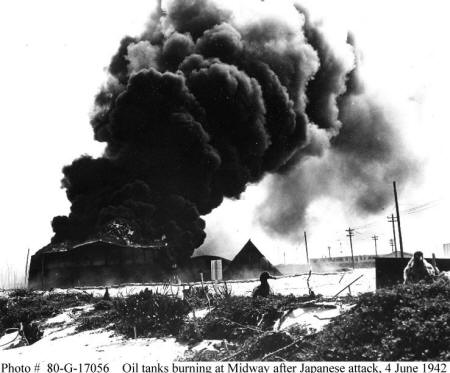
The Battle June 4, 1942
- Just after midnight on 4 June, Admiral Nimitz, based on patrol plane reports, advised Task Forces 16 and 17 of the course and speed of the Japanese "main body," also noting their distance of 574 miles from Midway. Shortly after dawn, a patrol plane spotted two Japanese carriers and their escorts, reporting "Many planes heading Midway from 320 degrees distant 150 miles!"
- The first attack on 4 June, however, took place when the four night-flying PBYs attacked the Japanese transports northwest of Midway with one PBY torpedoing fleet tanker Akebono Maru.
- Before dawn, 16 B-17s leave Midway for second attack on Japanese Invasion Force. PBYs depart in search of the Japanese carriers.
- At 0430 in the morning of 4 June 1942, while 240 miles northwest of Midway, Vice Admiral Chuichi Nagumo's four carriers began launching 108 planes to attack the U.S. base there. Unknown to the Japanese, three U.S. carriers were steaming 215 miles to the east. The two opposing fleets sent out search planes, the Americans to locate an enemy they knew was there and the Japanese as a matter of operational prudence. Seaplanes from Midway were also patrolling along the expected enemy course. One of these spotted, and reported, the Japanese carrier striking force at about 0530.
- That seaplane also reported the incoming Japanese planes, and radar confirmed the approaching attack shortly thereafter. Midway launched its own planes. Navy, Marine and Army bombers headed off to attack the Japanese fleet. Midway's Marine Corps Fighting Squadron 221 (VMF-221) intercepted the enemy formation at about 0615. However, the Marines were immediately engaged by an overwhelming force of the very superior Japanese "Zero" fighters and were able to shoot down only a few of the enemy bombers, while suffering great losses themselves.
- The Japanese planes hit Midway's two inhabited islands at 0630. Twenty minutes of bombing and straffing knocked out some facilities on Eastern Island, but did not disable the airfield there. Sand Island's oil tanks, seaplane hangar and other buildings were set afire or otherwise damaged. As the Japanese flew back toward their carriers the attack commander, Lieutenant Joichi Tomonaga, radioed ahead that another air strike was required to adequately soften up Midway's defenses for invasion.
~ 0900 June 4th After The Initial Attack - PBY spots the Japanese carriers northwest of Midway at a heading of 330 degrees and at about 170 miles out.
- A second PBY reports "many planes" headed toward Midway.
- Seven AM - Ten torpedo planes were among the aircraft launched from Midway's Eastern Island airfield as the Japanese raid approached in the early morning of 4 June 1942. Four were Army Air Force B-26 "Marauder" medium bombers, which had been modified to each carry a Navy Mark XIII aerial torpedo. The other six were a detachment of the same Torpedo Squadron Eight (VT-8) that flew from USS Hornet (CV-8). Unlike their ship borne squadron mates, this group operated the newly-introduced TBF-1 "Avenger" torpedo plane, which had much better performance than the older TBD-1 "Devastator".
These ten torpedo planes were the first to encounter the Japanese carrier fleet, soon after 7:00 AM, and they received the intense and deadly attentions of the defending combat air patrol. Only one of the Navy TBFs survived, much shot up with one crewman killed. Two of the four Army planes got through. However, none of the torpedo planes hit a Japanese ship.
Remaining U.S. land-based aircraft take off from Eastern Island - B-26 bombers, Grumman single engine torpedo bombers TBF-1, Douglas Dauntless SBD-2 scout/dive bombers, and the Vought Vindicator scout/dive bombers.
The B-26 Marauder was an American World War II twin-engine medium bomber built by the Glenn L. Martin Company. The first bomber in the Pacific theater and Aleutian Islands in 1942, it was also used in the European Theater of Operations and in the North African Campaign. The plane distinguished itself as "the chief bombardment weapon on the Western Front" according to an Army Air Forces dispatch from 1946, and also because the B-26B maintained the lowest loss record of any combat aircraft during World War II. Its loss record stands in sharp contrast to its unofficial nickname "The Widowmaker".
 The Grumman TBF Avenger (designated TBM for aircraft manufactured by General Motors) was a torpedo bomber, developed initially for the United States Navy and Marine Corps and used by a large number of air forces around the world. It entered service in 1942, and first saw action during the Battle of Midway. During the Battle of Midway, all of the three aircraft carriers' torpedo groups (from the USS Hornet, USS Enterprise, and USS Yorktown) had taken horrendous casualties; one group had a single survivor (Ensign George Gay). This was partly due to the slow speed of the Devastator (less than 200 mph (320 km/h) during glide-bombing) and its weak defensive armament. Ironically, the first shipment of TBFs had arrived only a few hours after the three carriers quickly departed from Pearl Harbor (although a few eventually participated launched from Midway Island).
Avengers At Work - 0800 - Less than an hour behind Midway's torpedo planes were sixteen Marine Scouting Squadron 241 (VMSB-241) SBD-2 bombers. They attacked the Japanese carrier Hiryu , scoring a near miss and causing a few casualties with machinegun fire. Again, the Japanese combat air patrol handled the attackers roughly. Only eight of the Marine SBDs returned to Midway, of which but two were fit for further service.
- Then, somewhat after 0800, fifteen Army B-17s struck, raining down sticks of bombs from high altitude. Much was expected of this kind of attack, but no hits were scored, a result that further war experience would demonstrate was all-too-typical. On the other hand, the "Flying Fortresses" were little damaged by Japanese anti-aircraft fire and fighters. They made several fine photographs of the Japanese carriers maneuvering far below, an indication of the true role of these heavy bombers in contemporary maritime warfare: long-distance reconnaissance by aircraft capable of defending themselves.
 B17s Attempting A Hit On Japanese Carriers
 - Last of the Midway attack force were eleven Marine SB2U dive bombers, which came on the scene some minutes after the B-17s. These older planes attacked the battleship Haruna. They, too, made no hits, but most of them survived
- Midway fighter aircraft engage Japanese aircraft 30 miles from Midway and suffer heavy loss.
- Midway under attack - attack is over in about 20 minutes with major damage to facilities on Eastern and Sand Islands.
- Japanese Midway strike commander requests second strike/bombing of Midway.
- U.S. Aircraft from Midway begin attacking Japanese carriers - they score no hits and suffered heavy losses, except for the B-17s which were diverted to attack the Japanese carriers and recorded no hits.
- U.S. Carriers
Hornet
and Enterprise launch their aircraft to attack the Japanese carriers.
The seventh USS Hornet (CV-8) of the United States Navy was a Yorktown class aircraft carrier of World War II, notable for launching the Doolittle Raid, as a participant in the Battle of Midway, and for action in the Solomons before being irreparably damaged in the Battle of the Santa Cruz Islands.
She was launched 14 December 1940 by Newport News Shipbuilding of Newport News, Virginia, sponsored by Annie Reid Knox (wife of Secretary of the Navy Frank M. Knox), and commissioned at Norfolk 20 October 1941, Captain Marc A. Mitscher in command.
During the uneasy period before the attack on Pearl Harbor, Hornet trained out of Norfolk. A hint of a future mission occurred 2 February 1942 when Hornet departed Norfolk with two Army Air Force B-25 Mitchell medium bombers on deck. Once at sea, the planes were launched to the surprise and amazement of Hornet's crew. Her men were unaware of the meaning of this experiment, as Hornet returned to Norfolk, prepared to leave for combat, and on 4 March sailed for the West Coast via the Panama Canal.
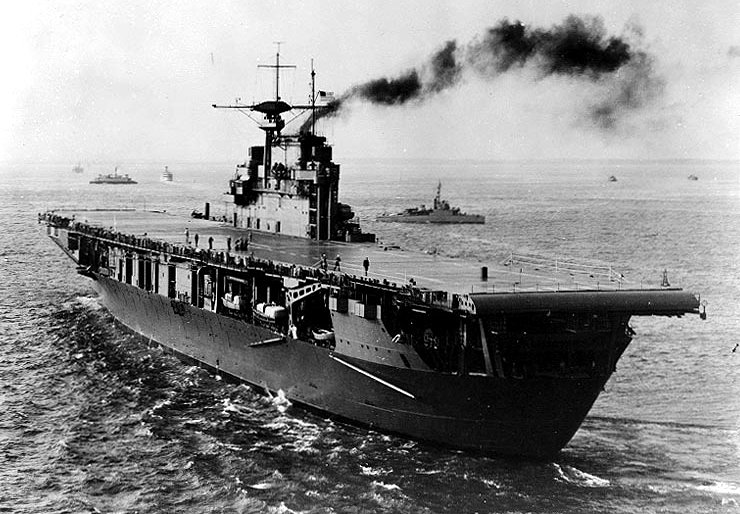 USS Hornet Ready To Sting
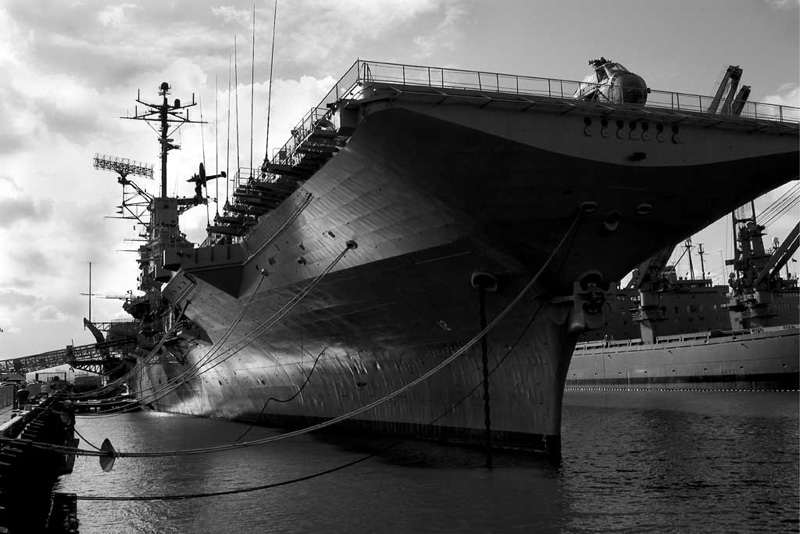 The Hornet, Still Alive And Well
- Japanese Admiral Nagumo orders rearming of planes he has prepared for a possible attack on U.S. ships with land bombs for second strike on Midway.
- Japanese scout plane locates portions of the U.S. Fleet and later the Yorktown.
- Yorktown responds by launching a limited strike with only half of its dive-bombers and fighters taking off.
- Nagumo decides to rearm all planes with torpedoes and armor piercing bombs to attack U.S. ships. Safety precautions are overlooked to ready the aircraft.
- Japanese aircraft return from Midway attack and Nagumo decides to wait to attack the U.S. ships with all aircraft. Japanese carriers turn northeast to engage the reported U.S. carrier.
- U.S. TBD2 Devastators, torpedo bombers from the Hornet and Enterprise attack the carriers without the protection of the Wildcat fighters. Yorktown TBDs attack the fighter escort but still suffer heavy losses. Forty out of 44 TBD2 aircraft are lost, with no hits. Ensign George Gay is the sole survivor of Hornet's Torpedo Eight.
 The Douglas TBD Devastator was a torpedo bomber of the United States Navy, ordered in 1934, first flying in 1935 and entering service in 1937. At that point, it was the most advanced plane flying for the USN and possibly for any navy in the world. However, the fast pace of aircraft development caught up with it, and by the time of the Japanese attack on Pearl Harbor the TBD was already outdated. It performed well in some early battles, but in the Battle of Midway the Devastators launched against the Japanese fleet were almost totally wiped out. The type was immediately withdrawn from service, replaced by the Grumman TBF Avenger.
- Japanese fighter aircraft protecting their carriers are running out of ammunition and fuel after mopping up after the torpedo bomber attacks.
- The SBDs plunged down on the startled
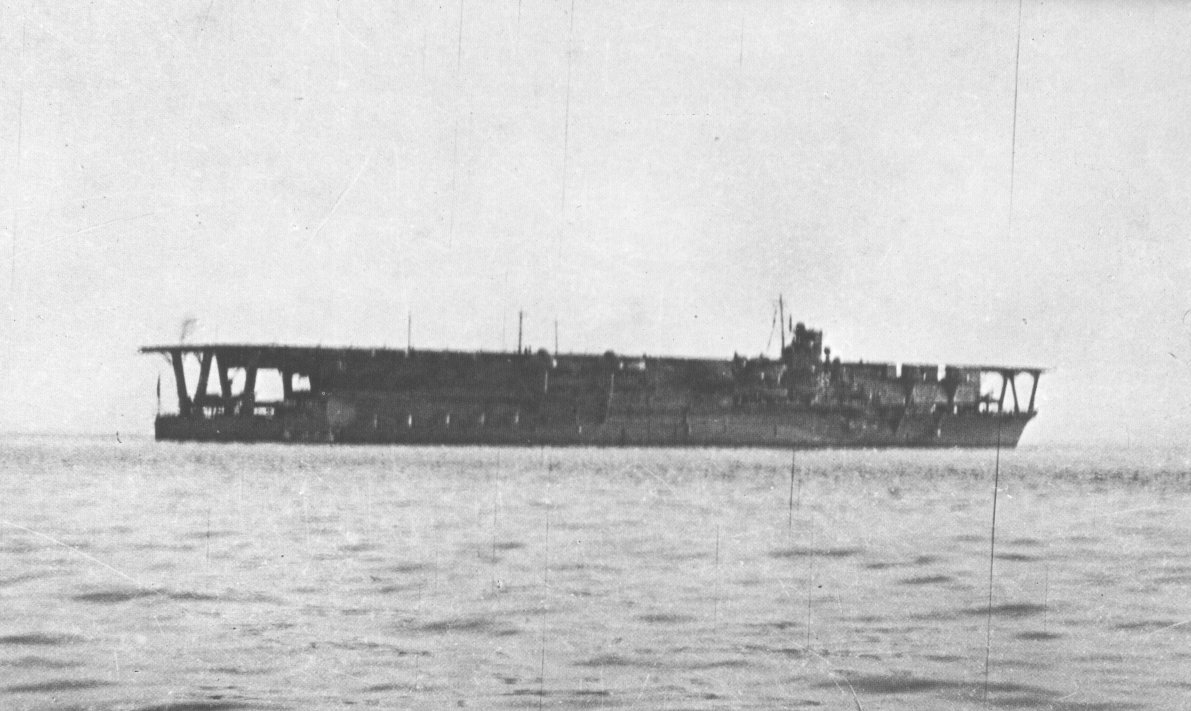 Japanese, who were turning into the wind to fly off their own striking force. Flight decks were crowded with armed, fueled planes, and hangar decks held other planes and much unstowed ordnance. Multiple bomb hits ignited fatal conflagrations on three of the four Japanese carriers, which were immediately put out of action, ending any realistic hope of Japanese victory in this battle. As they burned, Lieutenant Commander William H. Brockman, undeterred by earlier depth charge attacks, brought USS Nautilus in submerged and fired torpedoes at Kaga. However, as would commonly be the case until more than half-way through 1943, the only "fish" that hit failed to explode. Consumed by fires and explosions, Kaga and Soryu sank late in the afternoon. Akagi followed them before dawn the next day.
- Hornet's dive-bombers and fighters miss the initial action.
- Aircraft from the Hiryu launch an attack on the Yorktown - three bombs find their mark. Damage control parties had Yorktown underway at two-thirds speed with all fires controlled within two hours after the attack.
 Yorktown Under Attack
 - Second wave of Japanese aircraft from the Hiryu attack the Yorktown, thinking that it was another carrier; two torpedoes find their mark - Yorktown abandoned but remains afloat.
- Admirals Fletcher and Spruance turned the U.S. Fleet to the east to avoid a nighttime surface battle with the Japanese cruisers and battleships.