The Mayflower Was A Tiny Vessel
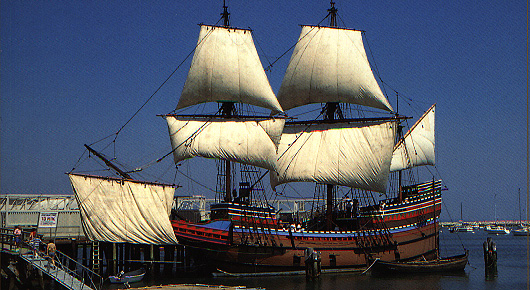 The Mayflower was fast, seaworthy ship and was about twenty years old. She had been in the wine trade in France and could carry one hundred & eighty tons. No one is sure exactly what the ship looked like. The ship was about ninety feet long and about twenty-five feet wide. The middle part of the main deck was open to the weather. Below this was the gun deck and below that was the hold.
There were high structures at the bow and stern of the ship. The one at the bow was the forecastle, where the crew slept and the cook had a brick wood-burning stove. The structure at the aft, the stern castle, had two short decks, one below the other. In one of these was the master's stateroom and the "great cabin," where the officers ate. In both there were also bunks for the more important passengers. Since this was the driest part of the ship, the flour and sea biscuits were stored here.
On the deck below was the steerage. Steering wheels and gear had not yet been invented. Instead, the ship was steered by a whipstaff, a beam attached to the tiller that ran through a sternpost down to the rudder. Some of the passengers slept in the shallop, an open boat that was stowed on the gun deck. Most of the passengers probably spread blankets on the planking that formed the floors of the decks.
Beside food, clothing and some pieces of furniture, the Pilgrims took along a supply of seeds, garden tools, saws, axes, hammers, gunpowder, and firearms. They also brought barrels of bright cloth, beads, knives and small mirrors to trade with the Indians.
It was gale season when they set sail. For days at a time they had to lower the sails and drift through gigantic seas. Seams in the deck opened, letting icy water down on the frightened passengers, many were sick. At the height of one gale a main beam in the middle of the ship had buckled and cracked. Several officers wanted to turn back, but the beam was repaired, and the ship's master Christopher Jones, said the ship was strong and tight.
Christopher Jones was an expert mariner and had commanded the Mayflower for twelve years. Beside the officers there were about twenty or more seamen. They cursed the Pilgrims and made fun of their constant praying. The pilgrims saw the hardships aboard ship as God's way of testing their faith and courage.

After more than two months at sea, land was finally sighted. They were at Cape Cod, just north of the Hudson River. Heading south they ran into shoals and breakers. They took shelter at Provincetown Harbor where the Pilgrim leaders drew up the Mayflower Compact.

There were too many Indians around Cape Cod and not enough fresh water. They decided to go to Thievish Harbor but could not find it, so they landed at a place they called Plymouth. The Pilgrims sheltered in the ship for the winter. In January & February of that first winter, sometimes two or three people died in a single day. Many died of scurvy, a sickness caused by the lack of fruit and vegetables. Some would have died from pneumonia and typhus. The sick were lodged in the storehouse and the Mayflower became a hospital ship. The ship left in April for the return trip to England.
The Pilgrims were on their own, three thousand miles from home. In the spring the fragrant pink arbutus bloomed, which they called the mayflower. The large stream that flowed into Plymouth they named Jones River after the ship's master.