A Visit North With The Porter's And The Hale's
From Saratoga, California
Other Exhibits And Time To Visit Aunt Kaye (Page Thrfee)
We did a quick visit to the other displays in the building.
Africa
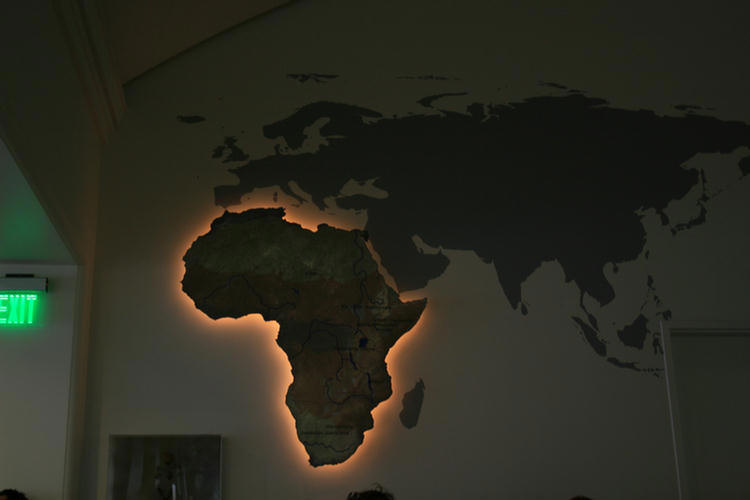

Beautiful hall containing dioramas
Did you know? - The word diorama can refer either to a nineteenth century mobile theatre device, or, in modern usage, a three-dimensional full-size or miniature model, sometimes enclosed in a glass showcase for a museum. The current, popular understanding of the term “diorama” denotes a partially three-dimensional, full-size replica or scale model of a landscape typically showing historical events, nature scenes or cityscapes, for purposes of education or entertainment.
Miniature dioramas are typically much smaller, and use scale models and landscaping to create historical or fictional scenes. Such a scale-model based diorama is used, for example, in Chicago's Museum of Science and Industry to display railroading. This diorama employs a common model-railroading scale of 1:87. Hobbyist dioramas often use popular scales such as 1/35th or 1/48.
Frank M. Chapman, a curator at the American Museum of Natural History during the late nineteenth and early twentieth centuries, helped popularize the full-size style commonly seen today. Shepard Paine, a prominent hobbyist, popularized the modern miniature diorama beginning in the 1970s.

Great diorama's
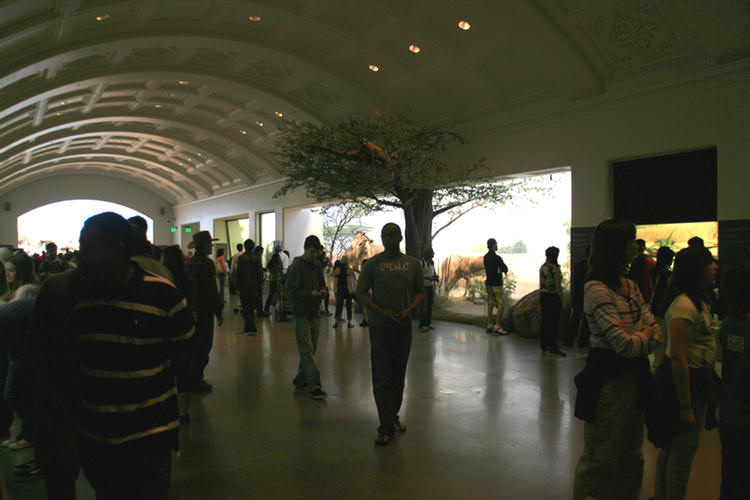
Many people were visiting the museum this Saturday


The African Weasel
Did you know? - Weasels are mammals in the genus Mustela of the Mustelidae family.
Originally, the name "weasel" was applied to one species of the genus, the European form of the Least Weasel (Mustela nivalis). Early literary references to weasels, for example their common appearances in fables, refer to this species rather than to the genus as a whole, reflecting what is still the common usage in the United Kingdom. In technical discourse, however, as in American usage, the term "weasel" can refer to any member of the genus, or to the genus as a whole. Of the 16 extant species currently classified in the genus Mustela, ten have "weasel" in their common name. Among those that do not are the stoat or ermine, the two species of mink, and the polecats or ferrets.
Weasels vary in length from fifteen to thirty-five centimeters (six to fourteen inches), and usually have a light brown upper coat, white belly and black fur at the tip of the tail; in many species, populations living at high latitudes moult to a white coat with black fur at the tip of the tail in winter. They have long slender bodies, which enable them to follow their prey into burrows. Their tails are typically almost as long as the rest of their bodies. As is typical of small carnivores, weasels have a reputation for cleverness and guile. They also have tails that can be anywhere from 22-33 cm long and they use these to defend the food they get and to claim territory from other weasels. The average weasel weighs about 198 grams (7 ounces).
Weasels feed on small mammals, and in former times were considered vermin since some species took poultry from farms, or rabbits from commercial warrens. Certain species of weasel and ferrets have been reported to perform the mesmerizing weasel war dance, after fighting other creatures, or acquiring food from competing creatures. In folklore at least, this dance is particularly associated with the stoat.


Did you know? - Zebras are African equids best known for their distinctive white and black stripes. Their stripes come in different patterns unique to each individual. They are generally social animals and can be seen in small harems to large herds. Zebras are generally 2.3 m (8ft) long, stand 1.25-1.5 m (4-5ft) at the shoulder, and weigh around 300 kg (660 lbs), although some can grow to more than 410 kg (900 lbs). In addition to their stripes, zebras have erect, mohawk-like manes. Unlike their closest relatives, horses and donkeys, zebras have never been truly domesticated.


Look carefully for the elephants on the wall... They are projected onto the diorama and move across the diorama

African Penguins

Did you know? The African Penguin (Spheniscus demersus), also known as the Black-footed Penguin or Jackass Penguin is found on the south-western coast of Africa, living in colonies on 24 islands between Namibia and Algoa Bay, near Port Elizabeth, South Africa, with the largest colony on Dyer Island, near Kleinbaai. Two colonies were established by penguins in the 1980s on the mainland near Cape Town at Boulders Beach near Simon's Town and Stony Point in Betty's Bay. Mainland colonies probably only became possible in recent times due to the reduction of predator numbers, although the Betty's Bay colony has been attacked by leopards. The only other mainland colony is in Namibia, but it is not known when this was established.
Boulders Beach is a tourist attraction, for the beach, swimming and the penguins. The penguins will allow people to approach them as close as a meter (three ft).
The closest relatives of the African Penguins are the Humboldt Penguin and Magellanic Penguins found in southern South America and the Galápagos Penguin found in the Pacific Ocean near the equator.

They had funny markings on their tummies
Let's See The Fish Of The Rainforest

Keeping the fish warm and well lit is important

Nothing like sitting down under 20 feet of water!


"Oh oh... What is that fish doing??"

One heck of a cat fish
Did you know? Catfish (order Siluriformes) are a very diverse group of bony fish. Named for their prominent barbels, which resemble a cat's whiskers (though not prominent in all members of this order), catfish range in size and behavior from the heaviest, the Mekong giant catfish from Southeast Asia and the longest, the wels catfish of Eurasia, to detritivores (species that eat dead material on the bottom), and even to a tiny parasitic species commonly called the candiru, Vandellia cirrhosa.


You are seeing from the basement up to the roof (five stories up) through the water!


"M-m-m-m-m-m-m If the glass broke what would happen?"

Into The Aquarium Proper
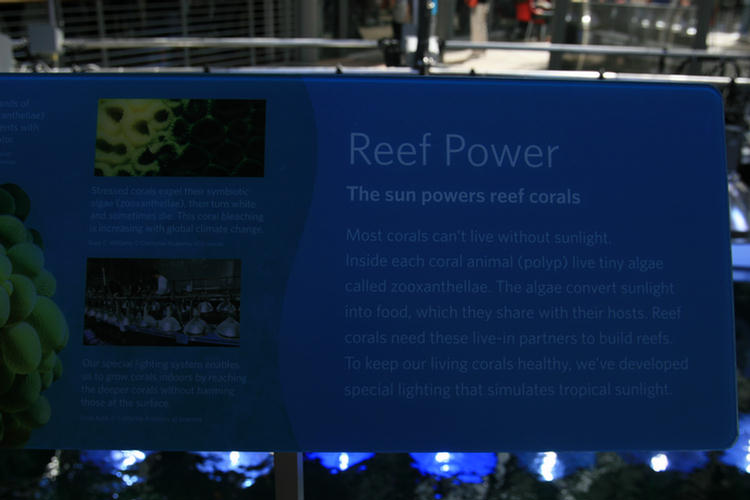

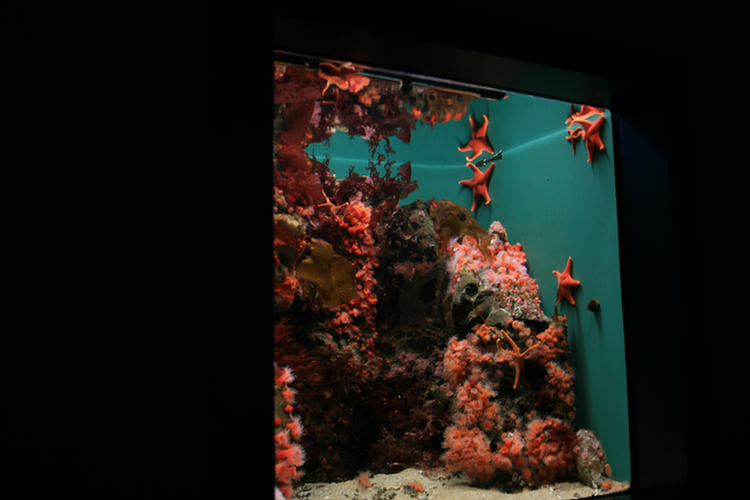


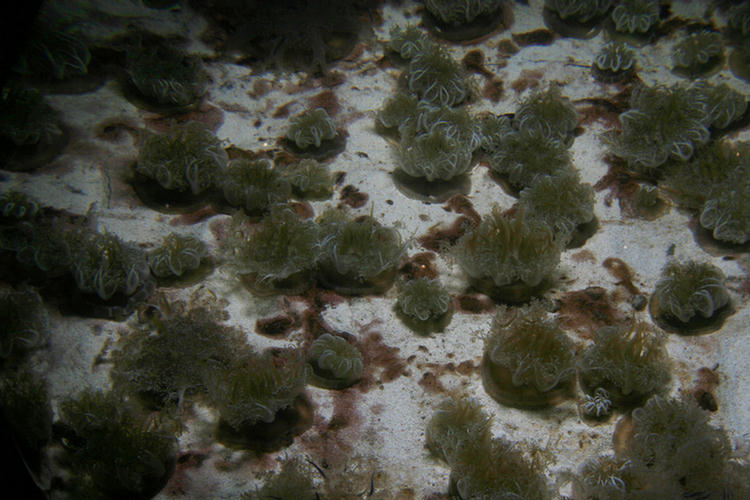
Did You Know? - The Cassiopea jellyfish (one common species is Cassiopea andromeda) belongs to the Order Rhizostomeae and mostly lives in sandy areas and seagrass beds. The Cassiopea jellyfish is also called "Upside Down Jellyfish", because it lies on its back, so that the bell touches the ground. In this position it resembles a sea anemone. Sometimes this jellyfish is picked up by a crab (Dorippe frascone) and carried on its back. The crab uses the jellyfish to defend itself against possible predators.

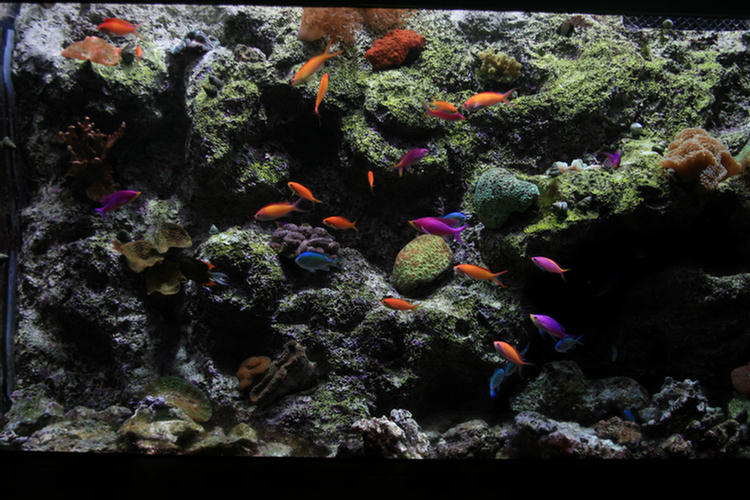
Bright colors everywhere


Did You Know? - Locals often use piranha teeth to make tools and weapons. Piranha are also a popular food, although if an individual piranha is caught on a hook or line, it may be attacked by other (free) piranhas.
Piranha are commonly consumed by subsistence fishermen and often sold for food in local markets. In recent decades, dried specimens have been marketed as tourist souvenirs. Piranhas occasionally bite and sometimes injure bathers and swimmers, but truly serious attacks are rare and the threat to humans has been largely exaggerated. For example, in the James Bond film You Only Live Twice, the villain has a pool of piranha fish which can strip a human body to the bone. A piranha bite is sometimes considered more an act of carelessness than that of misfortune, but piranhas are a considerable nuisance to commercial and sport fishers because they steal bait, mutilate catch, damage nets and other gear and may bite when handled.
Several piranha species appear in the aquarium trade. Piranhas can be bought as pets in some areas, but they are illegal in much of the United States including Alabama, Alaska, Arizona, Arkansas, California, Colorado, Florida, Georgia, Hawaii, Kentucky, Louisiana, Maine, Massachusetts, Mississippi, Nevada, New Mexico, New York, North Carolina, Oklahoma, South Carolina, Texas, Utah, Virginia and Washington.
The most common aquarium piranha is the Pygocentrus nattereri, or the red-bellied piranha. Piranhas can be bought fully grown or as babies, often no larger than a thumbnail. It is important to keep Pygocentrus piranhas alone or in groups of four or more, not in pairs, since aggression among them is common and is distributed more widely when kept in larger groups, not allowing the weaker fish to survive. It is not rare to find individuals with one eye missing due to a previous attack. If underfed, piranhas are likely to become cannibalistic on others in their group.
Some say the human-ripping piranha legend started with Teddy Roosevelt — and a setup by the Brazilians. To guarantee a good show for the adventure-loving Roosevelt, local fishermen blocked off a portion of an Amazon river with nets and dumped hordes of starving piranhas into it when the U.S. president explored the region on a hunting trip. Then they sliced up a cow and tossed it in the river, setting off a wild feeding frenzy, producing the now-fabled instant skeleton effect. Roosevelt declared the fish evil, and the media traveling with him spread the tale around the world. Hollywood would later emblazon the image for posterity.
Time To Head Home


Did You Know? - The Madagascar hissing cockroach (Gromphadorhina portentosa), also known as the hissing roach or simply hisser, is one of the largest species of cockroach, reaching 2–3 inches (5-8cm) at maturity. They are from the island of Madagascar off the African coast, where they can be found in rotting logs. Unlike most cockroaches, they are wingless. They are excellent climbers and can scale smooth glass.
Males can be distinguished from females by their thicker, hairier antennae and the pronounced "horns" on the pronotum. Females carry the ootheca (egg case) internally, and release the young nymphs only after the eggs have hatched. As in some other wood roaches, the parents and offspring will commonly remain in close physical contact for extended periods of time. In captivity, these insects can live 5 years. They feed primarily on vegetable material.
Eat, Visit, And Off We Go

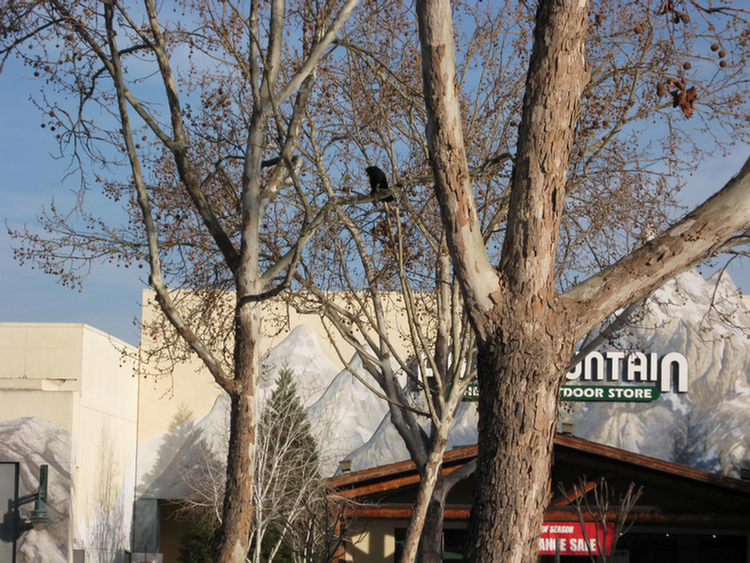

Lisa picked Maxim's for her birthday celebration


Someone is shy tonight!


Visit With Kaye

Sunday morning we are off to Aunt Kaye's

The highway was wide open


Aunt Kaye and Cousin Tom