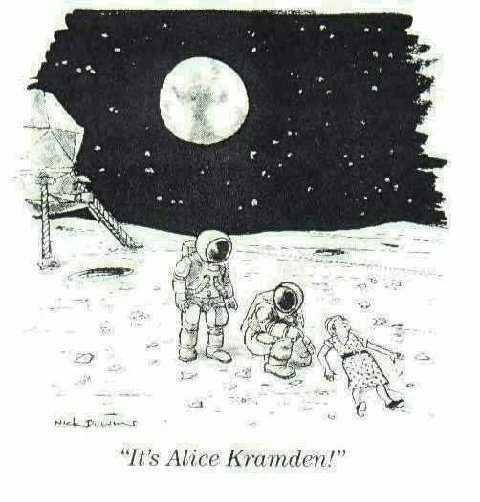
Apollo Command Service Module (CSM)
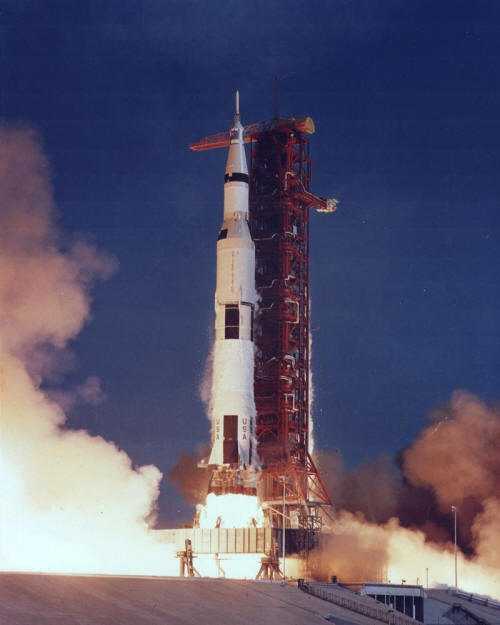
From Earth To The Moon, A Fantastic Journey!
Paul worked on Apollo from 1966 thru 1974 and had the opportunity to meet and work with the Astronauts in addition to participating in the J-Series Missions... The science missions to the moon! Sue worked Shuttle from 1975 through 1984.
Paul was honored by working with such great leaders a George Jeffs, Charlie Feltz, Ed Smith, Sy Rubenstein, Charlie Helms, Ben Boykin, and many many true leaders! These leaders drove the people hard, asked the right questions, rewarded true above-and-beyond effort and served the Government well by doing the right things!
I cut my teeth on the
Acceptance Checkout Equipment.
We did not know what was possible but the spirit was there. 60 hour weeks were common place and no whining over "overtime"... except for the union pukes!
It was a team efforts to be part of the adventure or a life time.
B1-B Air Force Bomber

B1, America's Russian Deterrent. Sue worked on B1-B for years leading the ground software development activity.
The B-1 Lancer is an American strategic bomber with variable geometry wings. Its origins began in the 1960s as a supersonic bomber with sufficient range and payload to replace the original B-52 Stratofortress. The B-1B production version has been in service with the United States Air Force (USAF) since 1986. The Lancer serves with the B-52 and the B-2 Spirit as the supersonic-capable component of the United States's long-range bomber force. As with several official popular names, the Lancer is commonly called the Bone within the US Air Force. With the retirement of the EF-111 Raven in 1998 and the F-14 Tomcat in 2006, the B-1B is the last swing wing aircraft remaining in the US inventory.
GPS - Global Positioning Satellite & Ground Segment

Finding Your Way Anywhere
Sue was the Ground Segment Program Manager for Boeing on the GPS program for years leaving it when the program moved to Anaheim and the travel time was impossible.
The Global Positioning System (GPS) is the only fully functional Global Navigation Satellite System (GNSS). Utilizing a constellation of at least 24 medium Earth orbit satellites that transmit precise microwave signals, the system enables a GPS receiver to determine its location, speed and direction.
Developed by the United States Department of Defense, it is officially named NAVSTAR GPS (Contrary to popular belief, NAVSTAR is not an acronym, but simply a name given by Mr. John Walsh, a key decision maker when it came to the budget for the GPS program). The satellite constellation is managed by the United States Air Force 50th Space Wing. The cost of maintaining the system is approximately US$750 million per year, including the replacement of ageing satellites, and research and development. These costs are funded by the US and GPS is free for civilian use as a public good.
Space Shuttle Orbiter
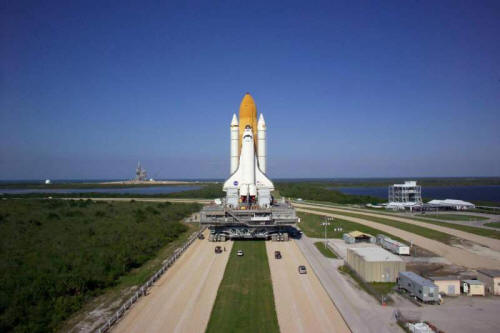
Amazing Complexity And National Pride At Work!
We both worked on the Space Shuttle for years. Sue began in the software development department for the Avionics Development Laboratory. Paul began as Project Engineer for the Avionics and Software Systems on the Shuttle.
NASA's Space Shuttle, officially called Space Transportation System (STS), is the United States government's current manned launch vehicle. At launch, it consists of a now rust-colored, but formerly white colored, external tank (ET), two white, slender solid rocket boosters (SRBs), and a winged orbiter (the space shuttle in the narrow sense).
The orbiter carries astronauts and payload such as satellites or space station parts into low earth orbit. Normally, five to seven astronauts ride in the orbiter, with two pilots. Eight have been carried, and eleven could be accommodated in an emergency landing. The payload capacity is 50,000 lb (22,700 kg). When the orbiter's mission is complete, it fires its orbital maneuvering thrusters to drop out of orbit and re-enters the Earth's atmosphere. During the descent and landing, the shuttle orbiter acts as a glider and makes a completely unpowered ("dead stick") landing. Five space worthy orbiters were built, of which three remain.
International Space Station Proposal
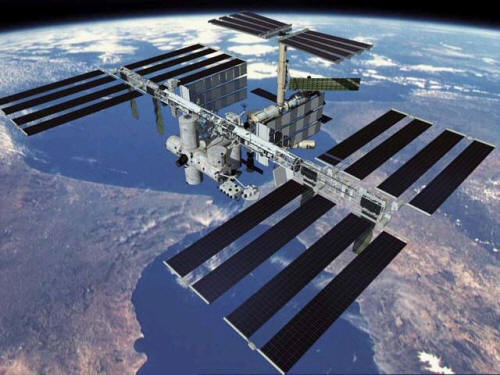
Sue and Paul worked on the ill-fated Rockwell bid on the Space Station for the Rockwell Company. We were bedding against McDonnell-Douglas and we really thought we had it locked.
But alas, we didn't! In retrospect, that was probably good as we would have been traveling all the time. We both left and went to Seal Beach to join the fledgling Being Satellite Development Division which has several satellite systems in development. Rockwell would have made a better choice with their legacy of manned space experience.
The International Space Station (ISS) is a research facility currently being assembled in outer space. The station is in a low Earth orbit and can be seen from earth with the naked eye: its altitude varies from 319.6 km to 346.9 km above the surface of the Earth (approximately 199 miles to 215 miles). It travels at an average speed of 27,744 km (17,240 miles) per hour, completing 15.7 orbits per day. The ISS is a joint project between the space agencies of the United States (NASA), Russia (RKA), Japan (JAXA), Canada (CSA) and several European countries (ESA).