When Johnny Comes Marching Home
| When Johnny comes marching home again,
Hurrah! Hurrah! We'll give him a hearty welcome then Hurrah! Hurrah! The men will cheer and the boys will shout The ladies they will all turn out And we'll all feel gay, When Johnny comes marching home. The old church bell will peal with joy Hurrah! Hurrah! To welcome home our darling boy Hurrah! Hurrah! The village lads and lassies say With roses they will strew the way, And we'll all feel gay When Johnny comes marching home. Get ready for the Jubilee, Hurrah! Hurrah! We'll give the hero three times three, Hurrah! Hurrah! The laurel wreath is ready now To place upon his loyal brow And we'll all feel gay When Johnny comes marching home. |
About This Music
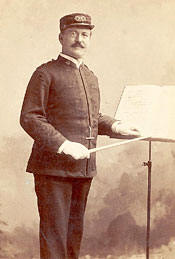 The story of "When Johnny comes Marching Home" is also the story of Patrick Sarsfield Gilmore. Gilmore, an 1848 Irish immigrant to Boston, was considered by no less a musician than John Philip Sousa as the "Father of the American Band."
Gilmore led a number of bands in the Boston area, including Patrick Gilmore's Band. At the beginning of the Civil War, in September 1861, the band enlisted as a group in the Union Army and was attached to the 24th Massachusetts Infantry. Gilmore's band served both as musicians and stretcher bearers at such horrific battles as Bull Run, Antietam, Chancellorsville, Gettysburg and Richmond. Gilmore was posted to occupied New Orleans, Louisiana in 1863 and, as Grand Master of the Union Army, ordered to reorganize the state military bands. It was at this time that he claimed to have composed the words and music to "When Johnny Comes Marching Home."
"When Johnny Comes Marching Home" bears a remarkable similarity of the melody of the Irish song "Johnny, I Hardly Knew Ye," which might be considered a protest song in the vein of "Where Have All the Flowers Gone?" The Irish song concerns conscription into the British Army
Where are your legs that used to run, huroo, huroo,
Where are your legs that used to run, huroo, huroo,
Where are your legs that used to run when first you went for to carry a gun?
Alas, your dancing days are done, och, Johnny, I hardly knew ye.