The Star Spangled Banner
It is the Sandi Patty arrangement, arranged by Tamara K. Gross. Courtesy of Ms. Gross. Please visit her site at http://ChartsForChurches.com |
|
Oh, say can you see, by the dawn's early light,
On the shore, dimly seen through the mists of the deep,
And where is that band who so vauntingly swore
Oh! thus be it ever, when freemen shall stand
|
|
About This Music
It was the valiant defense of Fort McHenry by American forces during the British attack on September 13, 1814 that inspired 35-year old, poet-lawyer Francis Scott Key to write the poem which was to become our national anthem, "The Star-Spangled Banner." The poem was written to match the meter of the English song, "To Anacreon in Heaven." In 1931 the Congress of The United States of America enacted legislation that made "The Star-Spangled Banner" the official national anthem.
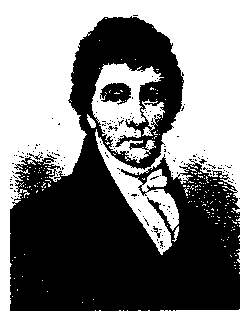 Francis Scott Key, son of an established Maryland family, was born on August 1, 1779, in western Maryland (Frederick, MD) on the family estate of "Terra Rubra." He attended grammar school and later graduated from St. Johns College in Annapolis at age 17.By 1805, Key had established a law practice in Georgetown, Maryland, and, by 1814, had appeared many times before the U.S. Supreme Court. The site of his house on M Street is now a memorial park.
Key was a religious man and was involved in the Episcopal church. Although opposed to the war, he served for a brief period in the Georgetown Light Field Artillery (1813-14). During the Battle of Bladensburg, Key assigned field positions to American troops - a duty he had no expertise in!
In August 1814, Key's friend Dr. William Beanes was taken prisoner by the British army soon after its departure from Washington. Key left for Baltimore to obtain the services of Colonel John Skinner, the government's prisoner of war exchange agent. Together they sailed down the bay on a truce ship and met the British fleet. Key successfully negotiated the doctor's release, but was detained with Skinner and Beanes by the British until after the attack on Baltimore.
Key's vessel (name unknown) was 8 miles below the fort during the bombardment, under the watchful care of a British warship. It was from this site that he witnessed the British attack on Fort McHenry, after which he was inspired to write the words to "The Star-Spangled Banner."
After the war, Key served as a United States District Attorney and continued his association with the Episcopal church, writing several hymns. On January 11, 1843, he died of pleurisy while visiting his sister in Baltimore. Today he rests in Mount Olivet Cemetery in Frederick, Maryland. The flag he so honored flies day and night here, and at Fort McHenry, as a reminder of those events in September 1814 that gave birth to our anthem and pride in our nation. (Note: There are also local monuments to Key at Fort McHenry, on Eutaw Place in Baltimore, and at the Presidio in San Francisco, California.)
Key was the brother-in-law of Roger Brooke Taney who served as Chief Justice and administered the oath of office to Lincoln in 1861.