"T Hunts" Were Fun
Best Hobby A Young Man In The 1950's Could Have!
We Had Young Men Around Us Helping... Why You ASK?
The girls worked in Paul's Dad's dime store and Paul junior told them how much fun a T-Hunt was. They said "We will give it a try!"

It took Ed and I a few more years to understand why the guys were always so willing to help us out! Duh!

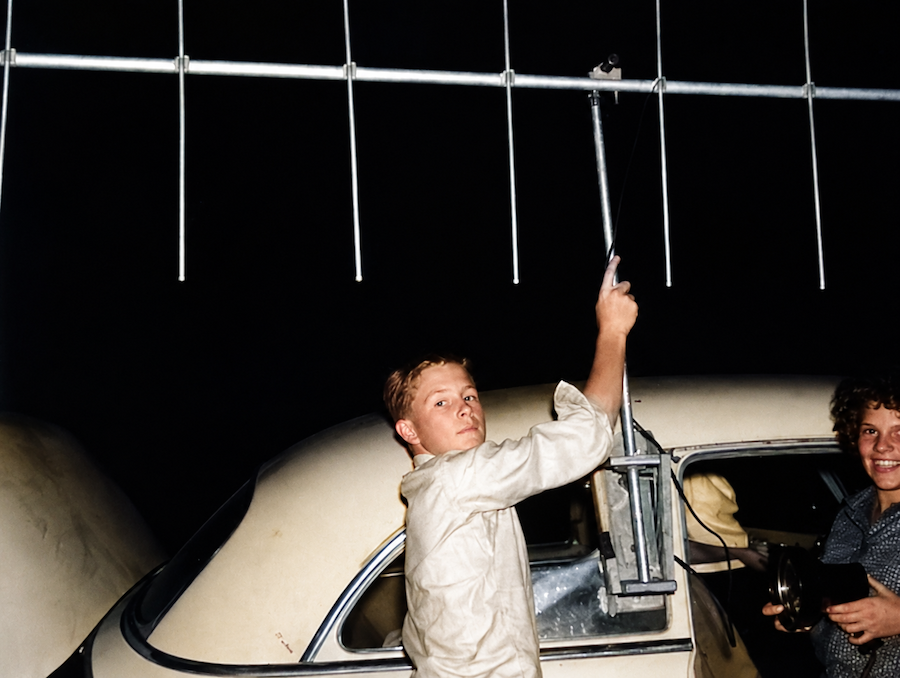
Judy was the driver and Paula the navigator. Ed and I turned the antenna, watched the S-Meter, and yelled "Left", "Right", "Straight-Ahead" or whatever!
We had a load of fun that evening!!!

Thank you, AI!!
Two-Meter Transmitter Hunts We A Saturday Night Activity
Transmitter hunting is an activity wherein participants use radio direction finding techniques to locate one or more radio transmitters hidden within a designated search area. This activity is most popular among amateur radio enthusiasts, and one organized sport variation is known as Amateur Radio Direction Finding. Other terms used to describe the activity include Radio-Orienteering, T-hunting, Fox Hunting, Bunny Hunting, and Bunny Chasing.
Ok..It's me 50+ years ago... this is an antenna which we put in the back windows of a 53 Chevy... we turned it manually to determine which direction to drive!
We had a ten element yagi on the side of the car
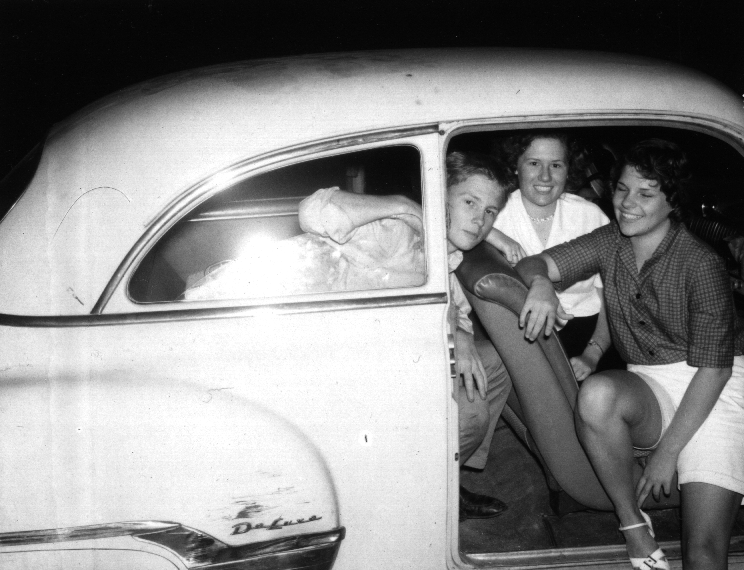
Ed and Paul could not figure out why the older guys hung around us?
We now know! Duh!!
The older guys who used to ignore us suddenly became our best buddies, wonder why???
After the hunt was over we all met for coffee and pie. Ed and I ate the pie ad watched the parade of gentlemen visit with our ride for the evening!
We did this several times and got to see of a lot of Los Angeles.
What Is A "T-Hunt"?
Mobile transmitter hunts refer to organized events where participants travel exclusively or primarily in motor vehicles. Most mobile transmiiter hunts use VHF transmitters and receivers. Some participants use radio direction finding equipment and antennas mounted on a vehicle. Others use antennas that are temporarily deployed in an open window or an opening in the vehicle roof, and that can be easily rotated by hand while the vehicle is in motion.
Other participants employ handheld antennas and radios that can only be used when the vehicle is stationary. Some mobile transmitter hunts require participants to leave their vehicles and proceed on foot to reach the actual location of the radio transmitter.
The winner of a mobile transmitter hunt can be either the first vehicle to arrive at the hidden transmitter, or the vehicle that travels the shortest overall distance to locate the hidden transmitter. Some hunts also feature a separate "mail-in" competition, in which teams in fixed locations work together to locate hidden transmitters, then secretly give the coordinates to the organizers without actually traveling to the site.
The team which provides the closest coordinates wins, thus a team which believes that the transmitter is in the northwest parking lot at 2nd and Elm (if it actually is there) will beat a team which says that the location is 2nd and Elm.
This type of hunt enables participation by contestants who are unable to travel, such as shut-ins, school groups, etc., and requires a greater level of skill and coordination. Mobile transmitter hunts are more popular in North America than other parts of the world.

Green-eyed Gonset Communicator