The Toppers Dance Club Has Been Dancing For !
All good things must come to an end but with the after effects of COVID19 and the increase in fees and limited venues, our club of half a century had to fold. The last dance was December 3rd 2021 where many of us said our goodbyes. Many of us with move to Starlighters but it also is struggling. The end of an era. The site will remain up for us to each out and see our memories.

Our Last Dance Before COVID19 Was September 20th 2019
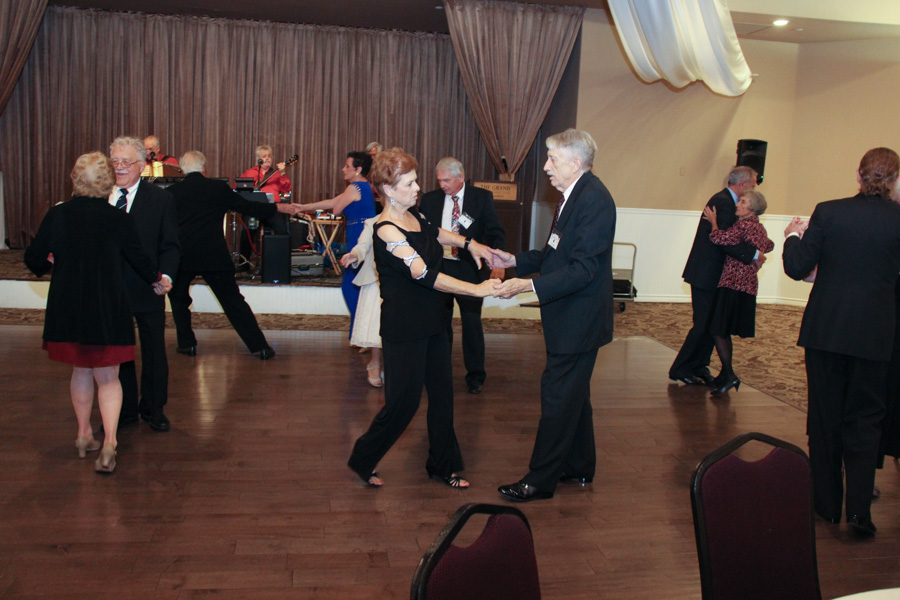
Dancing at the Long Beach Grand
Our Final Dance After 75 Years December 3rd, 2021
Perhaps A Little History?
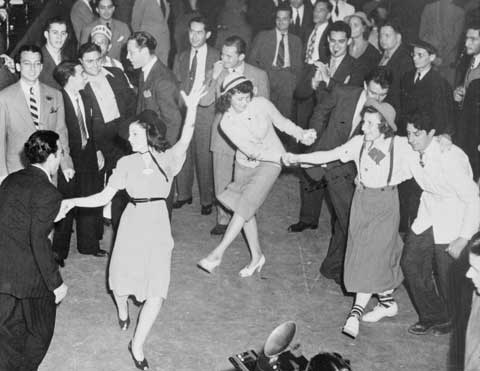
Topper's in 1946
The Topper's Dance Club was formed in 1946 in Long Beach and has been in operation ever since,
We meet and dance nine times a year, usually on a Friday night at the Petroleum Club beginning in September and the last dance is in May. We take the summer off to rest, relax, and get ready for a new season of dancing.
The Long Beach Petroleum Club was founded in 1953 as Long Beach’s premier social club. Although its origins were in the region’s oil industry, today, its diverse membership encompasses a broad spectrum of business, professional, charitable, and community organizations, individuals, and families.
Great people just enjoying a delightful dinner, dancing, and company. We are a mix on young and older who enjoy the sounds of dance music provided by several local bands.
Please join us in pictures for some of the dances we have had recently (due to the magic of the Internet and digital cameras).
What Was Going On When Our Club Formed???
January 10 - The first meeting of the United Nations is held in London. Project Diana bounces radar waves off the Moon, measuring the exact distance between the Earth and the Moon, and proving that communication is possible between Earth and outer space, effectively opening the space age.
January 29 – The Central Intelligence Group is established (the CIA in 1947).
February 14 - ENIAC (for "Electronic Numerical Integrator and Computer"), an early general-purpose electronic computer, is unveiled at the University of Pennsylvania.
April 1 - A 14-meter high tsunami strikes Hilo and Laupāhoehoe on the Big Island of Hawaii; 173 are killed, thousands injured.
May 7 – Tokyo Telecommunications Engineering (later renamed Sony) is founded with about 20 employees.
June 3 – The Interpol organization re-founded, telegraphic address "Interpol" adopted.
July 1 – Nuclear testing: Operation Crossroads, a series of nuclear weapon tests conducted by the United States at Bikini Atoll in Micronesia, is initiated by detonation of Able at an altitude of 520 feet (158 m).
December 20 - Frank Capra's It's a Wonderful Life, featuring James Stewart, Donna Reed, Lionel Barrymore, Henry Travers, and Thomas Mitchell, is released in New York.
December 31 – President Harry Truman delivers Proclamation 2714, which officially ends hostilities in World War II.
Dancing Is A Way Of Life...

The Toppers Phenakistoscope

Turning and turning...
Did you know? - The phenakistoscope (also spelled phenakistiscope) was an early animation device, the predecessor of the zoetrope. It was invented in 1832 simultaneously by the Belgian Joseph Plateau and the Austrian Simon von Stampfer.
One variant of the phenakistoscope was a spinning disc mounted vertically on a handle. Around the center of the disc a series of pictures was drawn corresponding to frames of the animation; around its circumference was a series of radial slits. The user would spin the disc and look through the moving slits at the disc's reflection in a mirror.
The scanning of the slits across the reflected images kept them from simply blurring together, so that the user would see a rapid succession of images with the appearance of a motion picture (see also persistence of vision).
Another variant had two discs, one with slits and one with pictures; this was slightly more unwieldy but needed no mirror. Unlike the zoetrope and its successors, the phenakistoscope could only practically be used by one person at a time. The phenakistoscope was only famous for about two years due to the changing of technology.
The first part of the term 'phenakistoscope' comes from the root Greek word φενακίζειν - phenakizein, meaning "to deceive" or "to cheat", as it deceives the eye by making the pictures look like an animation. As technology along with popularity increased in the early twentieth century, coin operation was utilized on machines, coining the term "Nickelodeon," which would be later be used somewhat freely to describe events charging five cents or a "nickel."