* Heritage: valued objects and qualities such as cultural traditions, unspoiled countryside, and historic buildings that have been passed down from previous generations.
We Checked, Not A Single Horse Thief Anywhere.... So Far (Page One)
I am from simple folks who lived, loved, worked and passed on into the next world after following their beliefs that "one should do on to others as you would like to be done to!" I'd call them "salt of the Earth", see below:
The best people. Farmers were described as the best, the salt of the earth, particularly when their products were needed to feed the army.
Etymology: based on the high value salt had in the past, and used in the Bible
The Depression Shaped Me Indirectly...
It is August 1939 and Americans are still recovering from the Great Depression--the worse nightmare that has ever happened to the United States. For the last ten years, since 1929, this country has experienced total economic collapse. Who could have imagined that this would happen in our modern industrial world?
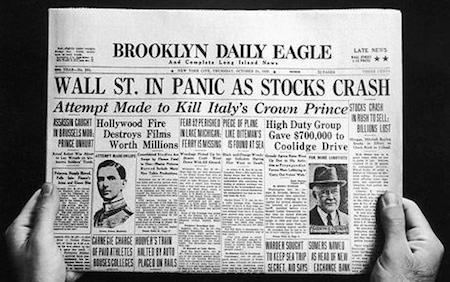
The depression affected everyone. No jobs to be had to there was a need to go west in search of employment
The Wall Street stock-market crash of 1929 signaled the beginning of this Great Depression, even if it did not actually cause it. Ten years have passed and this economic depression has had devastating effects on most people in this country.
Production fell sharply. Unemployment went through the roof. No one had much money, so purchasing declined. Thousands of businesses and hundreds of banks have closed. We are a country of small farmers, but farmers everywhere have gone into bankruptcy.
People lost their jobs, homes, and savings, and now many depend on charity to survive. In 1933, more than 15 million Americans--one-quarter of the nation's workforce--were unemployed.
In the south it was pretty bad. It was time to move on!
Dad Was An Arkie And Mom Was An Okie
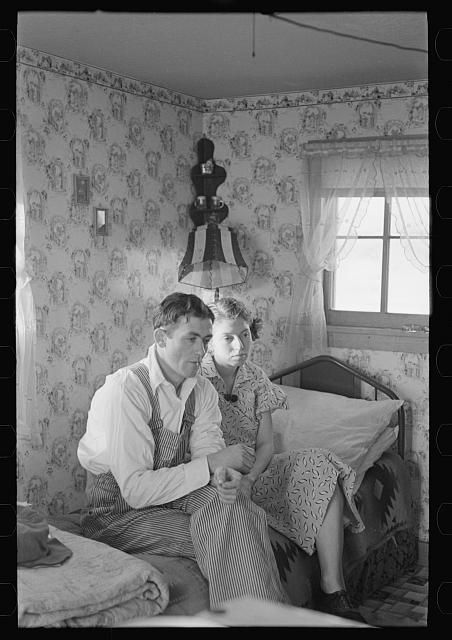
Dad's sisters had already gone west in 1930
"Okie" in relation to the Great Depression, it was a term used for migrant farmers and families, especially from Oklahoma, who moved west—often to California—during the Dust Bowl and Great Depression.
It was often used as a derogatory nickname, though not all "Okies" were actually from Oklahoma; many came from nearby states like Texas, Arkansas, and Kansas.
The depression affected everyone. No jobs to be had to there was a need to go west in search of employment
In the 1930s on the West Coast, especially California, the term came to symbolize a migrant who left the South-central, Midwest and sometimes, Southeast United States to settle in masses to restart their lives in the region's agriculture and manufacturing industries. Most worked on farms, and in the shipyards and defense factories leading up to and following World War II. The Dust Bowl as well as a federal program which took farm land out of production caused many to lose or leave their homes.
Who All Came?
Rural Caucasian and American Indian farmers of Oklahoma, and from the Southern and Central states relocated to the Northeast and west coast since the 1850s, but the "Okie" migration of the 1930s brought in over a million new displaced residents to California's Central valley and major cities bucked the trend. Ben Redbrick, a free-lance journalist and later publisher of the Paso Robles Daily Press, is credited with first using the term Okie, in the mid-1930s, to identify migrant farm workers. He noticed the "OK" abbreviation (for Oklahoma) on many of the migrant’s license plates and referred to them in his article as "Skies." Californians began calling all migrants "Skies," regardless of whether they were actually from Oklahoma.
Many West Coast residents and some politically motivated writers used Redbrick's term to disparage these poor, white (including those of mixed American Indian ancestry, the largest tribal group being Cherokees), migrant workers and their families. The term was made famous nationwide by John Steinbeck's novel The Grapes of Wrath.
Will Rogers, an Odie immigrant to California himself, once remarked jokingly that the Skies arriving in California increased the average intelligence of both states.
Mom and Dad indeed came to California in 1933 after not being able to continue to live in the Louisiana.
Coming To California...
Picture the 1930s! The Great Depression is in full swing. The Wall Street stock-market crash of 1929 precipitated the Great Depression, the worst economic downturn in the history of the United States. The depression had devastating effects on the country. The stock market was in shambles. Many banks couldn't continue to operate. Farmers fell into bankruptcy. A quarter of the working force, or 13 million people, were unemployed in 1932, and this was only the beginning. The depression lasted over a decade, with hundreds of thousands of Americans losing their jobs, businesses failing, and financial institutions collapsing.
Mom and Dad were married living in Arkansas and Louisiana looking for work. The economy was pretty bad in the South. I have a letter Dad wrote his sister Opal in 1936 asking if she would let him come out and look for a job in California. I never heard how they got here but I am sure it was an old broken down car and everything they owned piled into it... Think Beverly Hillbillies!
Alma & Opal Had Their Opinions
Two of my aunts, Alma and Opal, hated the Beverly Hillbillies because what they represented was too close to the truth. Dad tried to convince them that those people may have been "goofy" in the eyes of the Beverly Hills types but that they were HONEST, HARD WORKING, and FAMILY ORIENTED... Good decent people!
I have no idea what they drove to get out to California but I can image it probably looked just the the car int he picture. I often asked Mom and Dad if they really had a mattress tied to the top of the car, they never really gave me a direct answer. They were just happy to get out of poverty in the south and get a chance for a new life!
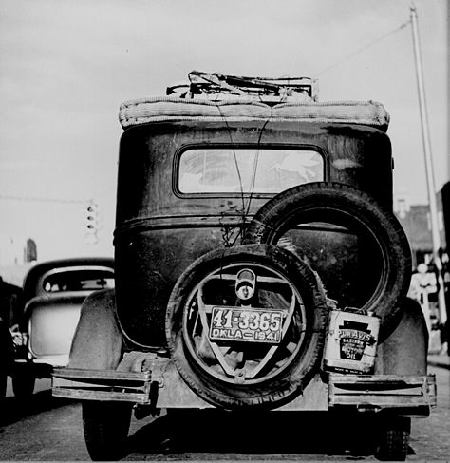
This car was about what they arrived in in 1933 California
after driving from Little Rock, Arkansas
Mom And Dad Came To California
Mom and Dad came to Downey, California where Aunt Opal had a large lot! Dad went to work for Ralph David Lebowitz... a relationship went on until Dad's death in 1970. Ralph had a dime store... and although he really didn't need any help, he allowed Dad to dress the windows part time and then finally hired him full time.
Mom and Dad were married July 24th 1927 just before the economy crashed. The economy was already pretty bad in the South and the prospects for making a living were slim to none. I have a letter Dad wrote his sister opal in 1933 asking if she would let him come out and look for a job in California. Mom and Dad came to Paramount, California where Aunt Opal had a large lot!
Dad went to work for Ralph David Lebowitz... a relationship went on until Dad's death in 1970. Ralph had a dime store... and although he really didn't need any help, he allowed Dad to dress the windows part time and then finally hired him full time. Store #1 was in Long Beach and Store #2 was in Los Angeles.
Dad's Letter To Aunt Opal
One of the few things I have from Dad is a letter he wrote in 1933 to his sister, Opal, who lived in California. It in essence said "There is no work in Louisiana and no prospects for any in the near future. Can Georgia and I come to California where we might have a future?"
Of course dad and mom came to California and stayed with Opal and Jimmy Robinson in a tiny tiny 500 square foot house until they could get established. The little house still exists as it was in the back one-third of a huge 300 foot deep piece of property.
Mom and Dad first moved into an apartment over a store on Paramount Boulevard where Dad got a job in Long Beach "dressing windows". After the boss, Ralph Lebowitz, opened two more stores in Los Angeles, Mom and Dad moved to Comey Avenue in West Los Angeles where they lived until 1962.
The Robinson & Parchman homes were originally on the land owned by the people on the right (whose names I have forgotten). The sold off these huge lots to my aunts and they built on them. First little houses in the back of the properties and in the 1950's they built new homes on the front of the property.
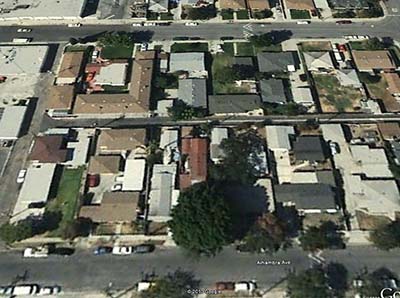
The Robinson and Parchman homes in Paramount, California 2007
Dad's Heart Was Always BIG
Upon going through cousin Kat's things after she had passed, I found a note signed by Opal and Jimmy to my Mother and Father because Dad apparently loaned them the money to buy and build the house!
Did I say "buy and build"? Yes, the home was a "kit" which cost $2,750 and the cost for putting it together (pouring the slab, plumbing, electrical, etc.) was another $1,800 or so.
I remember the note stated Aunt Opal and Uncle Jimmy would pay Mom and Dad $25/month until the loan was paid off
We Had A Large Extended Family...
Dad had four sisters and a brother while Mom had three brothers and a sister so I had eight aunts and uncles and then there were the eleven cousins. After growing up in the depression, the aunts and uncles did not have large family's... They learned the lesson of how hard it was to raise a family with all those mouths to feed... Plus they were now in the city and didn't need the help around the house.
On Dad's side we had Opal, Edith, Alma, Helen and Clarence Earl.
On Mom's side we had Charles, Earnest, Carl, and Mary Kathryn.
As of 2022, every one is gone to their rewards.
I grew up knowing Claudia (daughter of Edith Parchman). Kathryn (daughter of Opal) and Tom (son of Mary Kaye). The other cousins were either too far away to get to know or much older and had little in common with me.
It was interesting to note that in order of age there was Claudia, Tom, and me and we were all three months apart! Claudia and I had mothers in their 30's when we were born.
We lost Kat in 2010 but she lived to the ripe old age of 95. We lost Tom in 2017 at the ripe old age of 73. Mortality hit me like a ton of bricks as he was only three months older than me!

Growing Up A Child Of A Depression Family Meant...
It meant eating every bite of food on your plate, working hard, go to school, make something of yourself!
Growing up was fun in the 1940's and 1950's. Family and friends made life warm and fuzzy! The economy was doing great, the war was over and it was boom times. My folks had the 1930's philosophy of eat every bite on your plate, care for friends and family, work hard, God will provide! My mother and father were just great people and the older I get, the greater they were!