The Amazing Apple
The apple tree (Malus domestica) is a deciduous tree in the rose family best known for its sweet, pomaceous fruit, the apple. It is cultivated worldwide as a fruit tree, and is the most widely grown species in the genus Malus. The tree originated in Central Asia, where its wild ancestor, Malus sieversii, is still found today. Apples have been grown for thousands of years in Asia and Europe, and were brought to North America by European colonists. Apples have religious and mythological significance in many cultures, including Norse, Greek and European Christian traditions.
Apple trees are large if grown from seed, but small if grafted onto roots (rootstock). There are more than 7,500 known cultivars of apples, resulting in a range of desired characteristics. Different cultivars are bred for various tastes and uses, including cooking, eating raw and cider production. Apples are generally propagated by grafting, although wild apples grow readily from seed. Trees and fruit are prone to a number of fungal, bacterial and pest problems, which can be controlled by a number of organic and non-organic means. In 2010, the fruit's genome was decoded as part of research on disease control and selective breeding in apple production.
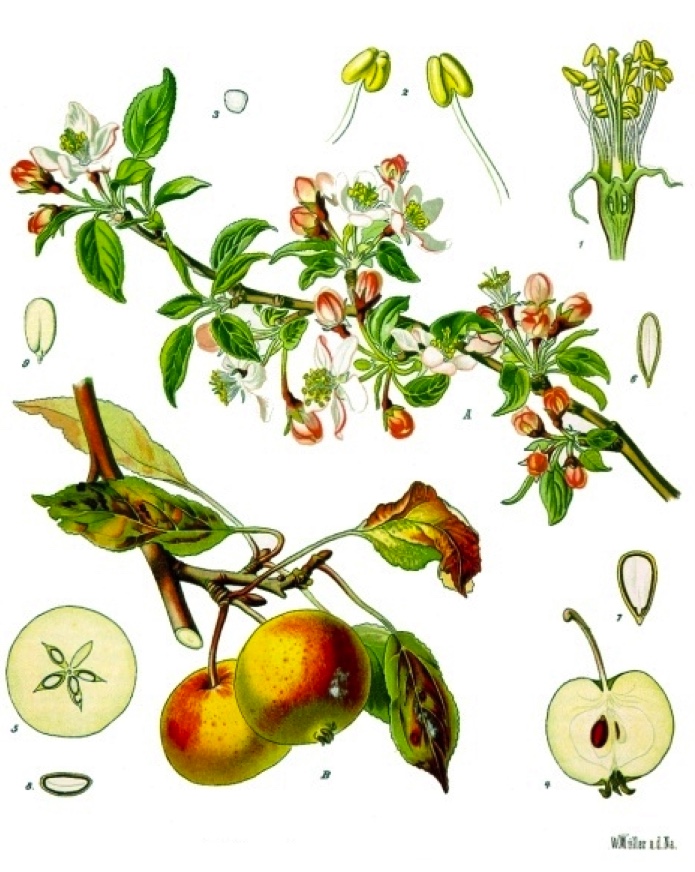
The fruit matures in late summer or autumn, and varieties exist with a wide range of sizes. Commercial growers aim to produce an apple that is 7.0 to 8.3 cm (2.75 to 3.25 in) in diameter, due to market preference. Some consumers, especially those in Japan, prefer a larger apple, while apples below 5.7 cm (2.25 in) are generally used for making juice and have little fresh market value. The skin of ripe apples is generally red, yellow, green, pink, or russetted although many bi- or tri-colored varieties may be found. The skin may also be wholly or partly russeted i.e. rough and brown. The skin is covered in a protective layer of epicuticular wax, The flesh is generally pale yellowish-white, though pink or yellow flesh is also known.
Apples were brought to North America by colonists in the 17th century, and the first apple orchard on the North American continent was planted in Boston by Reverend William Blaxton in 1625. The only apples native to North America are crab apples, which were once called "common apples". Apple varieties brought as seed from Europe were spread along Native American trade routes, as well as being cultivated on Colonial farms. An 1845 United States apples nursery catalogue sold 350 of the "best" varieties, showing the proliferation of new North American varieties by the early 19th century In the 20th century, irrigation projects in Eastern Washington began and allowed the development of the multibillion-dollar fruit industry, of which the apple is the leading product.