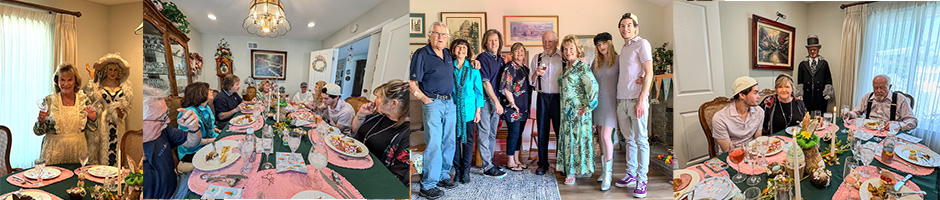
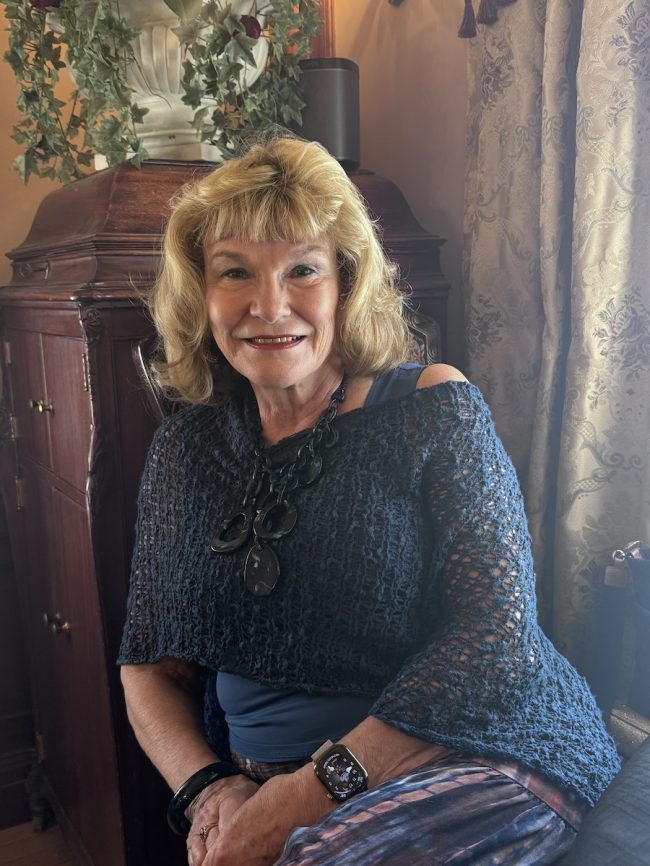
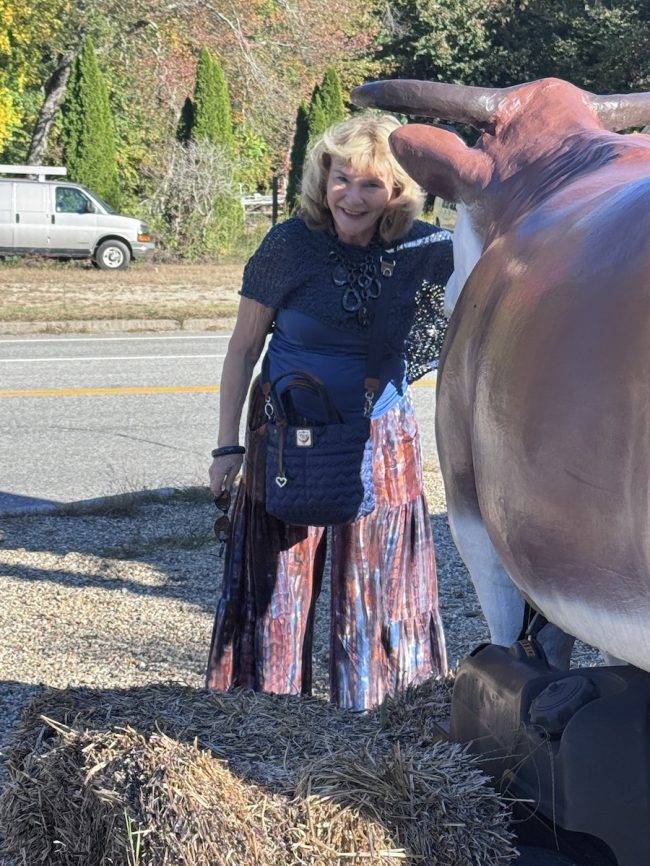
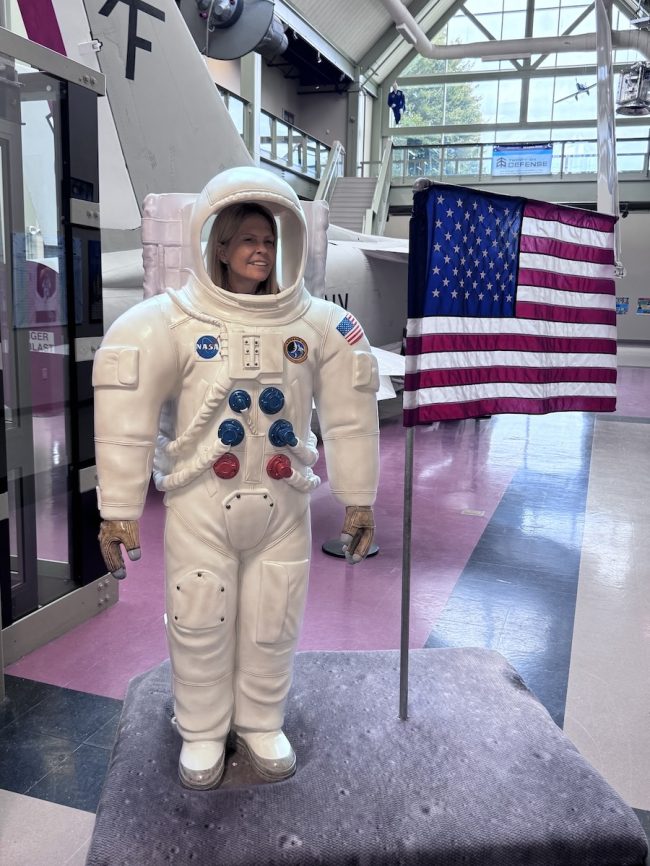
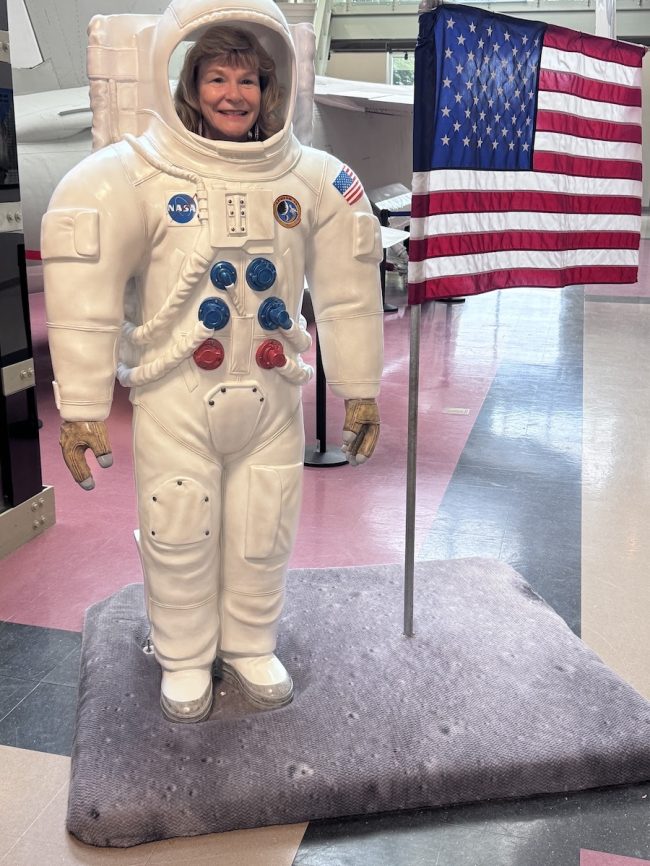
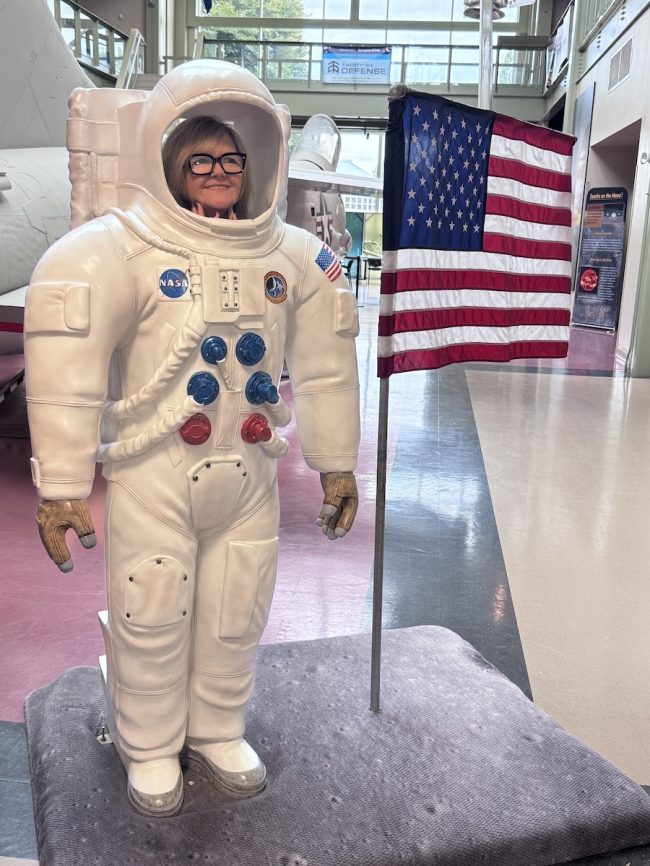
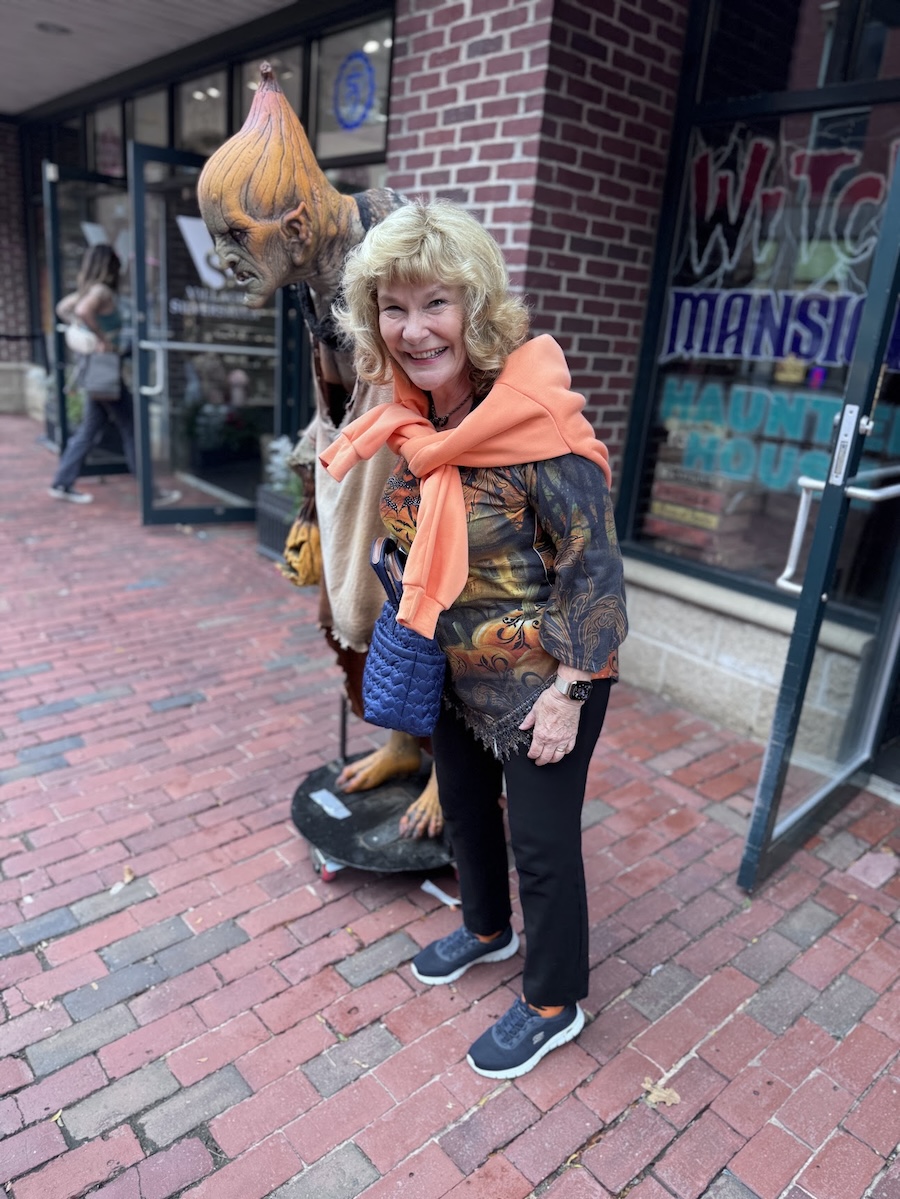
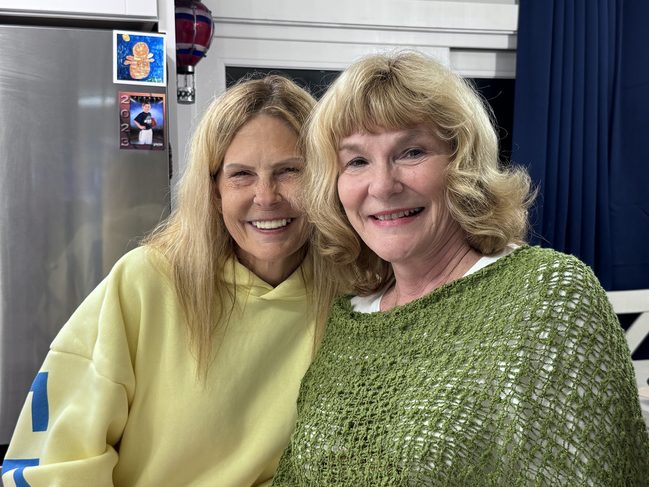
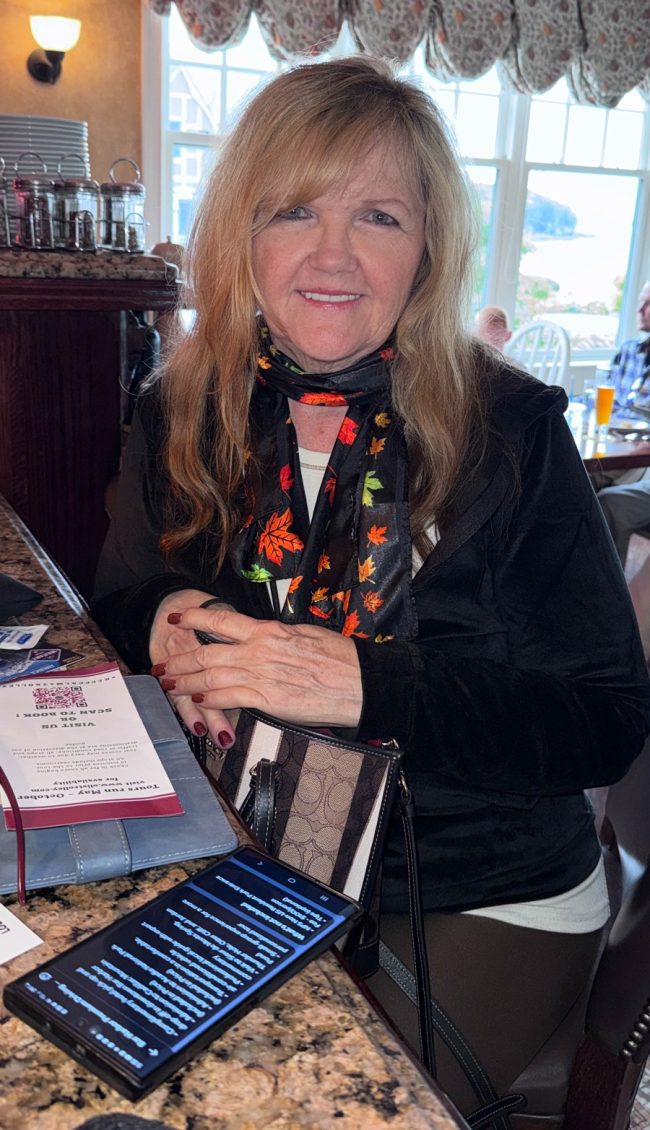
Mary got ready for breakfast wearing her Fall colors. Fall colors are just trees collectively agreeing to dress like they’re attending a pumpkin spice gala.
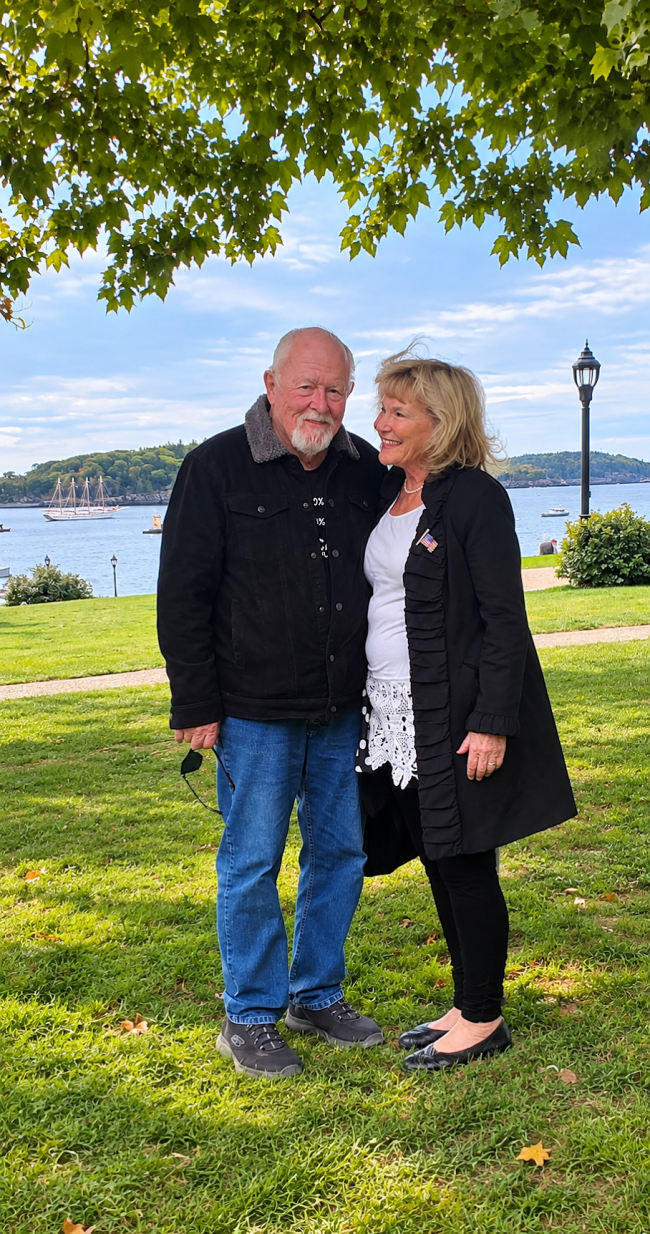
Having fun with family!!!
After a while, Mary changed back into her normal clothes, and we headed to breakfast at the inn—where the menus change so often, I’m pretty sure even the pancakes have commitment issues.
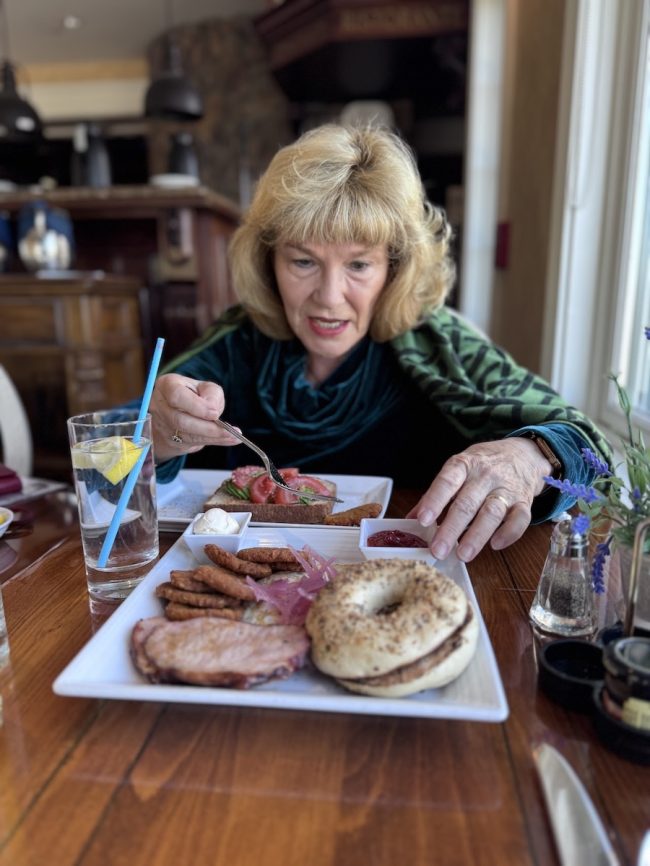
I went for the blueberry bake. A blueberry French toast bake is a breakfast casserole made with chunks or slices of bread soaked in a sweet egg-and-milk custard, mixed or topped with blueberries, then baked until golden.
It’s basically French toast made in a baking dish instead of sliced and pan-fried.
Common ingredients include:
Bread, often brioche, challah, French bread, or sourdough
Eggs
Milk or cream
Sugar or maple syrup
Vanilla
Cinnamon
Blueberries, fresh or frozen
Sometimes cream cheese or a crumb topping
It’s usually soft and custardy inside, with a slightly crisp top, and served warm with maple syrup, powdered sugar, or whipped cream. It’s popular for brunch because you can often assemble it the night before and bake it in the morning.
The inn is now fully decorated. I could have sworn that I heard the typewriter banging away last night.
What is the message???
A “Black Flame Candle” exists as a fictional/magical item, most famously from Hocus Pocus. You can buy replica Black Flame Candles as decorations, usually just black wax candles.
A “Black Flame Candle” exists as a fictional/magical item, most famously from Hocus Pocus. You can buy replica Black Flame Candles as decorations, usually just black wax candles.
As we walked outside to rest on the porch, Colleen and Mark arrived in a rather oversize Dodge pickup truck, and we left. How Mark managed to turn that beast around in the tiny inn parking lot still amazes us!
We came to the Holy Grail two years ago to say goodbye to family, so it is apparently a tradition
The Holy Grail Restaurant & Pub in New Hampshire is a well-known Irish-themed restaurant located in Epping, NH.
It is especially notable because it is housed in a former church, giving it a distinctive look inside and out. The building’s church-style architecture, stained-glass details, high ceilings, and pub décor make it a unique dining spot.
Basic overview:
Name: The Holy Grail Restaurant & Pub
Location: Epping, New Hampshire
Style: Irish pub / casual restaurant
Atmosphere: Historic, cozy, lively, and themed around medieval/Irish pub elements
Common menu items: Burgers, sandwiches, fish and chips, shepherd’s pie, steaks, seafood, appetizers, and drinks
Popular for: Dinner, drinks, casual gatherings, live music or events, and its unusual church setting
People often visit not just for the food, but also for the unique atmosphere. If you are planning to go, check their current hours, menu, and reservation options, as restaurant schedules can change.
The old church’s interior was decorated to the hilt.
He refused to smile for the picture!
The interior was large, with an Irish pub bar in the center. We sat off to the side with our backs to the fireplace, which was perfect.
Yes, it WAS a real church once upon a time.
There were TVs everywhere, as it is a sports bar, but I was hoping one would be playing Hocus Pocus!
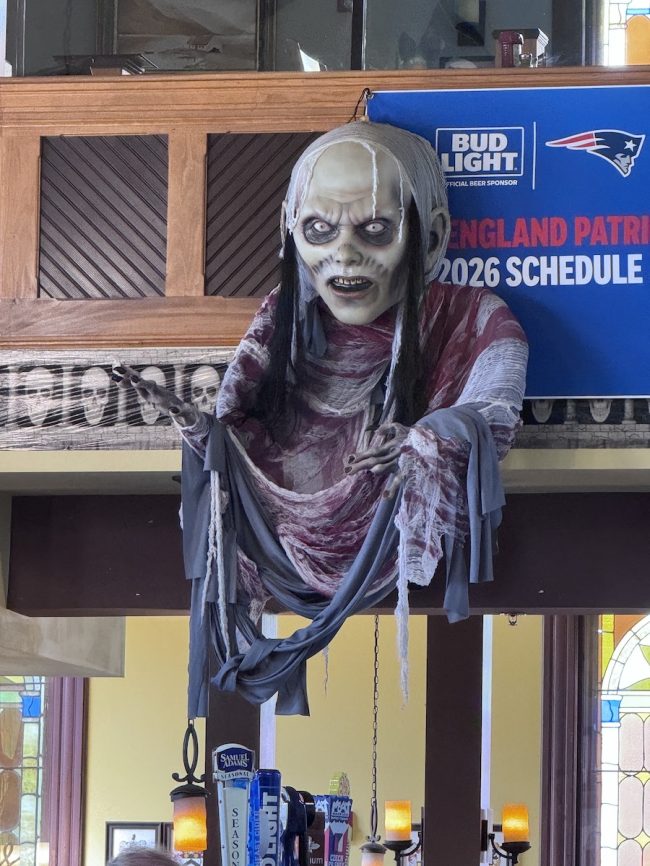
Our waitress was a little spooku herself.
The whole family came to say goodbye as we leave on Monday morning. It was fun to have the little ones come by and give us a hug, even Chunk (Ashton).
We had a table for twenty!
Sarah and Jon sat with us so we could plan next year’s cruise together. It could be a LA-to-Boston 16-day adventure. That way, we only have to fly one way!
Saying goodbye was hard—this week was an absolute blast. Of course, we’re pretty sure Colleen is more than ready to wave us off, lock the door, and enter a medically impressive hibernation after working so hard to make sure everything was perfect.
Bye Bye, Jon and Sarah!!
Bye bye everyone, see you soon!!
Colleen chauffeured us back to the inn, where we performed the ancient ritual of panic-packing. Then we watched Ghostbusters, turned down the candles like responsible Victorian adults, and immediately collapsed. Tomorrow: we fly!
Estimated reading time: 8 minutes
Our inn was just 2.1 miles from Colleen’s home.
We stayed in Dover, an hour north of Boston. Here are some fun facts about Dover, New Hampshire:
Oldest permanent settlement in New Hampshire: Dover was first settled in 1623, making it one of the oldest communities in the United States.
Nicknamed “The Garrison City”: The nickname comes from the fortified garrison houses early settlers built for protection.
Historic mill city: Dover grew into a major textile manufacturing center along the Cocheco River, and many old mill buildings still stand downtown.
Cocheco Falls powered industry: The falls in downtown Dover helped power the city’s early mills and factories.
Home to the Children’s Museum of New Hampshire: Located downtown, it’s a popular family attraction with hands-on exhibits.
Close to the seacoast but not directly on the ocean: Dover sits on the Cocheco River, which connects to the Piscataqua River and Great Bay.
Part of the “Tri-City” area: Dover is often grouped with Rochester and Somersworth as part of New Hampshire’s Seacoast region.
Lots of historic architecture: Downtown Dover has many preserved brick mill buildings, old homes, and 19th-century storefronts.
Henry Law Park is a local favorite: It hosts events, has river views, and is near the Children’s Museum.
Dover has a strong arts and food scene: Downtown has grown into a lively area with restaurants, breweries, cafés, galleries, and live music venues.
We had breakfast with Robin before she headed to the airport. Before leaving, she gave Mary detailed instructions on how to check in with the airline on Monday—because apparently, Mary needed a full pre-flight training seminar.
Then Colleen and Logann came by to collect Robin and whisk her away. Just three short flights later, she’ll be back home, lovingly reunited with 100-degree weather—because nothing says “welcome home” like being slow-roasted on arrival.
Checking in!
Breakfast was the perfect size—just enough to keep us going without feeling overstuffed. The local jams and jellies are outstanding. We emptied our plates in seconds! Over the teeth and through the gums, lookout tonsils, here it comes!
Mary is ready to go! We are off to Callan’s football game. Mark planned to pick us up at 1:00 pm and drive us to the “local” football field 45 minutes away.
Mary decided to “drive” by herself!
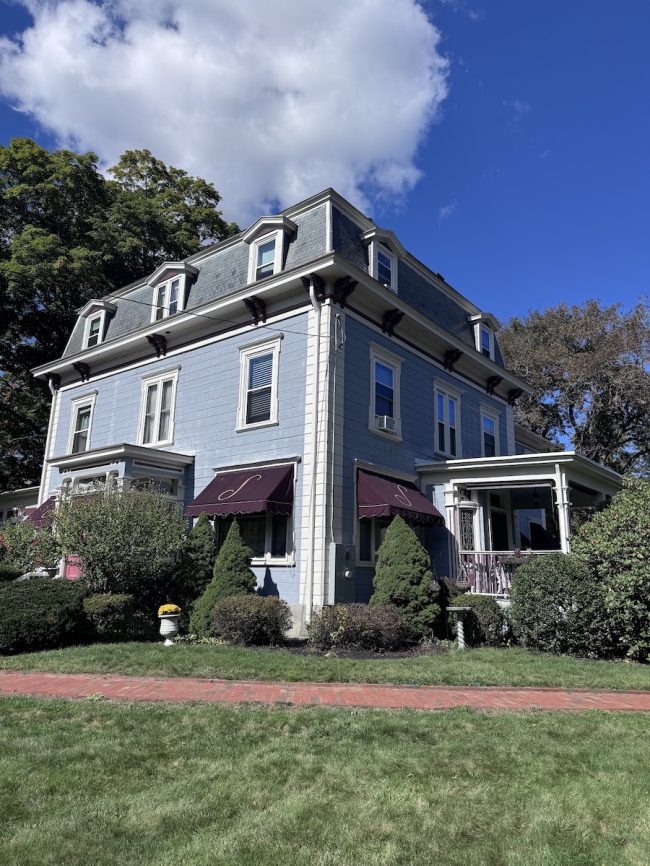
We had a few minutes, and the weather was perfect, so we walked around the Silver Fountain grounds. It is three stories and has a rather large basement. The basement was built with large locally sourced granite blocks.
In Victorian-era houses in New England, basements were usually formed as part of the original foundation construction, not “dug out” later—though some were later deepened or expanded.
The typical process was:
Excavation below frost depth – Builders dug a foundation hole deep enough to get below the frost line, which is important in New England because freezing soil can heave and crack shallow foundations.
Stone foundation walls were built – Many Victorian houses used fieldstone, granite, or other local stone laid in lime mortar. In some towns, brick or cut granite was also used. The stone walls supported the wooden house frame above.
A cellar space was left inside – The area enclosed by the foundation walls became the basement or, more commonly at the time, the cellar. It was often not intended as finished living space.
Dirt or rough floors were common – Many 19th-century New England cellars originally had packed earth floors. Concrete floors were often added later, especially in the early 20th century.
Used for storage and utilities – These spaces were used for storing coal, wood, root vegetables, preserves, and household goods. Later, they housed boilers, furnaces, plumbing, and electrical systems.
Drainage was often limited – Early basements did not always have modern waterproofing. Stone foundations were somewhat porous, and moisture was common. Some houses used perimeter drains, gravel, or simple grading to move water away, but many old New England basements remained damp.
In short, Victorian basements in New England were dug below grade, built with stone or brick foundation walls, and left as utilitarian cellars beneath the house. They were generally structural and practical, not finished, comfortable rooms like modern basements.
I hope I look this good at 250!
The Silver Fountain was kinda silver, but it needed some serious cleaning to remove the algae.
A neat walkway led to the front entrance, featuring a ten-foot arbor loaded with flowers.
Flowers were everywhere, and these were the most prevalent. They must be tough to last through the cold winter.
The property had a second house called The Carriage House, with a room that could hold 40+ people.
The neighborhood had many large homes!! Victorian homes in New Hampshire were often large for a mix of social, economic, and practical reasons:
Industrial and mill wealth – In the 1800s, many New Hampshire towns had textile mills, paper mills, shoe factories, railroads, logging, and related businesses. Successful mill owners, merchants, lawyers, doctors, and professionals built large houses to show status and prosperity.
Large families and multi-generational living – Families were often bigger than today, and it was common for extended family members—parents, adult children, unmarried relatives—to live under one roof.
Servants or hired help – Wealthier households sometimes had live-in domestic workers, so homes included extra bedrooms, back staircases, servant spaces, large kitchens, pantries, and work areas.
Entertaining and social status – Victorian culture placed importance on formal entertaining. Houses often had parlors, dining rooms, sitting rooms, libraries, and guest rooms. The house itself was a statement of respectability.
Cheaper land and local materials – In many New Hampshire towns, land was more available than in big cities. Timber and local building materials were relatively accessible, making it more feasible to build bigger homes.
Boarding and rental use – Some large homes took in boarders, seasonal visitors, teachers, mill workers, or tourists—especially in areas near rail lines, lakes, or the White Mountains.
Survivor bias – Many smaller Victorian-era homes existed too, but the large, ornate ones are more noticeable and more likely to have been preserved. So it can seem like “Victorian homes” were all huge, even though many were modest.
In short, large Victorian homes in New Hampshire usually reflected a combination of wealth, family size, social expectations, and the economic growth of 19th-century towns.
New Hampshire Victorian homes were usually built with local, durable materials, especially wood and stone.
Common materials included:
Wood framing
Most Victorian houses in NH were wood-framed.
Builders often used local pine, spruce, hemlock, or oak.
Many used balloon framing, which became common in the 1800s.
Granite or fieldstone foundations
New Hampshire has lots of stone, especially granite.
Many homes had granite block, fieldstone, or later brick foundations.
Wood siding
Exteriors were often covered with wood clapboards.
Some Victorian styles used decorative wood shingles, especially on gables and upper stories.
Brick
Brick was commonly used for chimneys, fireplaces, and sometimes foundations.
In mill towns or wealthier areas, some larger Victorian homes were built partly or entirely of brick.
Slate or wood roofs
Roofs might be covered with wood shingles originally.
Wealthier homes sometimes had slate roofs, which lasted much longer.
Plaster and wood interiors
Interior walls were usually wood lath with plaster.
Floors, trim, doors, and staircases were made of wood, often pine, oak, maple, or chestnut.
Decorative millwork
Victorian homes often had detailed porches, brackets, trim, and moldings made from wood.
New Hampshire’s mills made it easier to produce fancy decorative parts.
So, most Victorian homes in New Hampshire were built mainly from wood, set on granite or stone foundations, with brick chimneys, plaster interiors, and either wood, slate, or later asphalt roofing.
Mark was on time, and we headed down the highway to Callan’s School. About 84% of New Hampshire is forested.
That makes it one of the U.S.’s most heavily forested states, with forests covering roughly 4.8 million acres.
Once we got there, we met up with Colleen, Jon, Sarah, Cassie, and the kids.
We had front row seats!
Logann is a definite Renegade! She did all the moves just fine. Cassie is the cheerleader leader (naturally). Cassie has 27 girls in the group now, and it is growing.
The girls ranged from kindergarten to the 5th grade. They were fun to watch.
Watch out for #18; he is small but tough. We heard his name called out many times, as his lineman position had him sacking the QB and making other stops all game long.
Colleen borrowed a lens from brother Joe, and it weighed a ton!
After the game, we went to The Dark Horse Inn for dinner. Mary was talking to the cow, trying to get the “low-down” on the menu!!
We placed orders, and the girls visited, swapping stories and giggling a lot.
Ah ha! I almost caught Mark smiling, almost.
Jon wanted to try the tomahawk steak but settled for something less!
Mary and I love family!!
After dinner, Mark dropped us off at the inn. We had a cup of tea before retiring for the night. It was a good family day!
Today we stayed “home”. Colleen and Robin went to the market early and got the supplies we needed. Today the plan is:
Go shopping for supplies needed for cookie backing and apple sauce
Come to the Inn for a formal tea
Return to Colleen’s and make cookies
Visit
Breakfast was wonderful again, as the Silver Fountain Chef does a superb job every day! Mary is always fun to be with, so we had breakfast together while Colleen and Robin went shopping.
A magic potion was within her reach.
As I tried to ignore the ship sound, I saw something heading our way. Oh now, Mary has been at the computer again!
Oh my, they found her!
We sat and talked for a good hour before going to our room. I tried out the Sony camera that Joe gave me, and it appears to work fine. Robin came in from shopping, and we will be ready to make cookies with the great-grandkids this afternoon after the formal tea from 1:30-3:30 pm.
Meanwhile, Mary does some sewing.
We heard the great-grandchildren stampede downstairs and came to investigate. They told us they had scared a turkey out of the bushes, and it was a real gas!!
He was a REGULAR turkey, not supreme.
Time for Afternoon Tea with the princesses!!!
High tea is a British meal traditionally eaten in the early evening, usually with tea and substantial food.
Despite sounding fancy, high tea was originally more of a working-class evening meal. People served it at a high dining table after work, rather than on low lounge tables.
Typical high tea might include:
• Hot tea • Bread, butter, and jam • Meat pies or cold meats • Eggs or fish • Cheese • Cakes or scones
People often confuse it with afternoon tea, which is a more elegant, lighter service with tea, finger sandwiches, scones, and pastries, usually taken in the afternoon. So, simply put:
High tea = hearty evening tea meal?Afternoon tea = lighter, refined tea with snacks
The table was set for royalty; we had two princesses with us today!
We had a load of tea things and a mess of tea. The little girls enjoyed their teatime. Gail served us, and she kept things lively.
Afternoon tea usually includes a selection of small, elegant foods served with tea. Common items are:
Tea — such as Earl Grey, English Breakfast, Darjeeling, or herbal teas
Finger sandwiches — often cucumber, smoked salmon, egg mayonnaise, ham, or coronation chicken
Scones — typically served with clotted cream and jam
Pastries and cakes — such as éclairs, fruit tarts, macarons, Victoria sponge, or mini cakes
Biscuits or shortbread — sometimes included
It was served on a three-tier stand: sandwiches on one level, scones on another, and sweets on the top.
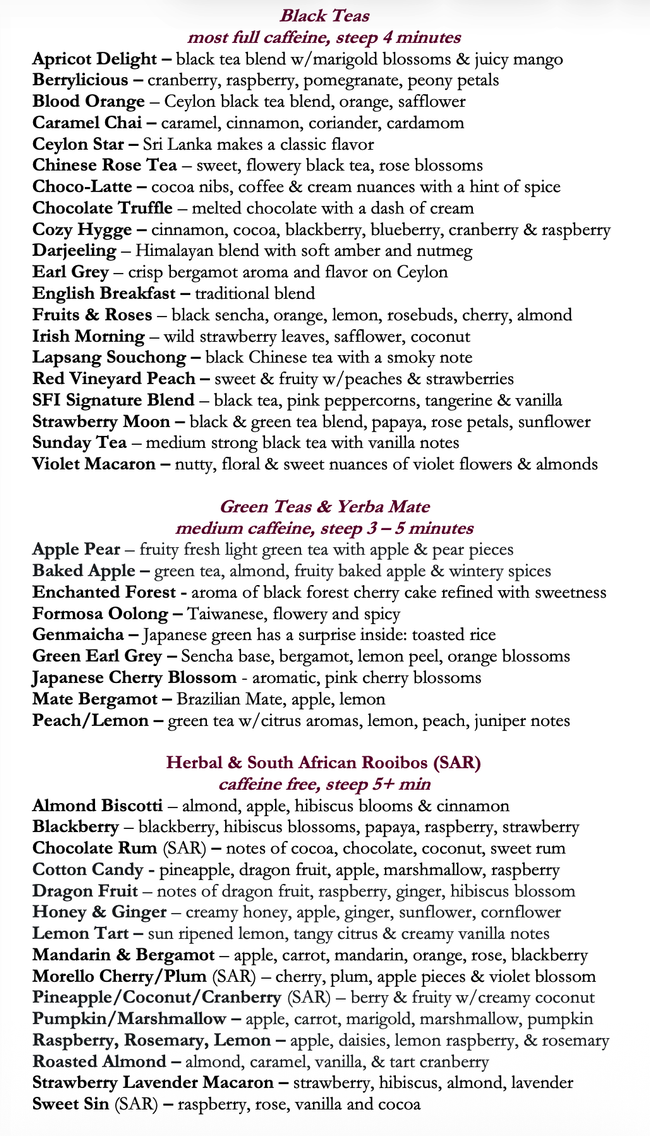
Decisions decisions
They had every team we could think of available!
Mary and I really enjoy afternoon tea, and watching the girls is a bonus.
Of course, we had our afternoon vino
The ladies seemed to enjoy their tea, and their Aunt Sarah bought them matching princess outfits.
Princess Emmy and Princess Logann arrived at the Silver Fountain Inn in New Hampshire wearing pink dresses, pink shoes, pink bows, and pink sunglasses, though it was raining. Their grandmother Colleen gasped. “You look like two cupcakes with elbows!”
Great-aunt Robin waved from the tea table beside Great-grandma Mary and Great-grandpa Paul. The table glittered with tiny sandwiches, scones, and teacups so fancy that Emmy whispered, “Do we have to bow to the cups?”
Logann bowed anyway, bumped the table, and made a spoon leap into Great-grandpa Paul’s lap. “The spoon likes you,” she announced.
Colleen poured tea. Emmsniffedff and said, “This soup smells like flowers.” Robin laughed so hard her hat slid sideways.
Mary offered cucumber sandwiches. Logann opened hers. “No peanut butter? This sandwich forgot its middle.”
Paul, trying to be royal, lifted his pinky. Emmy lifted both pinkies, then both feet, and nearly tipped backward.
At dessert, the waiter brought strawberry cakes. The princesses shouted, “Pink treasure!” and sprinkled sugar like fairy dust.
Meet Princess Emmy and Princess Logann
We needed spooky music during tea, so everyone looked online to buy spooky MP3 files!
Music selection is a family affair!
At the end of tea, we had to be scary since it is October in New England.
Now that is really scary (click to enlarge)
Bye bye tea, hello cookies!
We say goodbye to the Inn and go to Colleen’s home just 2.1 miles down the beaten path. When the princesses left, Robin found a scone in her purse. Logann smiled proudly. “For emergencies,” she said. “In case New Hampshire runs out of snacks.” Everyone agreed tea had never been sillier.
What time is it, boys and girls??? Yes, it is Tookie Time. Robin wanted to make cookies with the little ones, and while she made cookies, Mary and I made applesauce from yesterday’s purchase. Mary peeled while I chopped and made the lemon water (to keep apples from oxidizing and turning brown)
The Monsters are ready to bake!! Ashton joins the fun!!
The older kids also got involved!
I provided the necessary “Adult Supervision”. I was also watching Scooby-Doo and Hocus Pocus on TV in the family room.
Chunk (Ashton) watched in amazement.
While watching NCIS, I learned that the actor Sean Murray played Thackery Binx as a boy in Hocus Pocus and later became known for playing Timothy McGee on NCIS.
When the noise level got louder than a jet plane, Mark came in to see what was going on!! The kids’ volume doesn’t go up to 10 — it starts there.
“What in the world are you guys doing?”
Grandma supervises the activities! Colleen’s kitchen WAS spotless and very well organized!!! We did, however, have to send out for a rolling pin.
Being older adults, we often stand (sit or lie back and watch the activities. Mary found a good place to watch, well away from flying dough and sprinkle explosions!
Sammy the cat came to visit.
Everyone got into the act!
Cookie making went on for quite a while—turns out Sarah wasn’t just teaching decorating; she was running a masterclass in edible art. And methinks the older “girls” may have enjoyed it a little too much… though I’m sure it was purely for quality control!
All the colors of the rainbow!
Dining on the results is fun and messy!!
We visited, played with the kids, watched TV, and planned for tomorrow, finally departing around 9:00 pm.
It was a spooky night when we entered the Inn. We looked around before going into the open area to make sure the “gas turkey” wasn’t hiding in the bushes.
Colleen had a doctor’s appointment, so we lounged around the inn, had breakfast, and enjoyed some tea. Colleen came by at 11:30 am and we headed to the McAullife Museum. Breakfast was wonderful!!
YUMMY!!!!!
Our favorite witch was on duty making the Halloween decorations.
The McAuliffe-Shepard Discovery Center is a science and space museum in Concord, New Hampshire. It is named after Christa McAuliffe, the teacher-astronaut who died in the 1986 Challenger disaster, and Alan Shepard, the first American in space and a New Hampshire native.
The center focuses on space exploration, astronomy, aviation, and Earth science. It features interactive exhibits, spacecraft and aviation displays, educational programs, and a planetarium theater. Its mission is to inspire learning about science, technology, engineering, and mathematics, especially through the legacy of McAuliffe and Shepard.
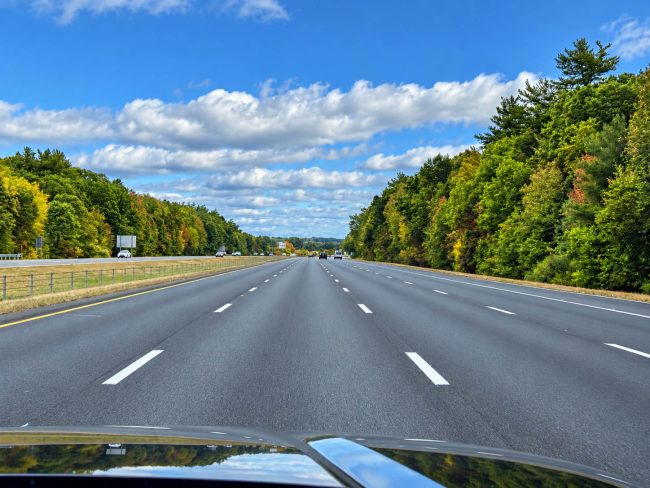
The drive to the museum took 65 minutes, and we drove through miles and miles of fall-colored trees.
The displays were very informative and well done for kids and adults.
We walked through all the exhibits, taking about two hours as we stopped to discuss several; I remembered more than I thought I would.
The kids would enjoy the little Mars robots.
Some of the displays were NOT meant to be interactive, but alas, we were NOT being supervised today.
We continued our walk and went upstairs for additional displays.
Suit up, ladies!!
They discussed the weather and saw a replica of the first weather station at the top of Mount Washington. Mount Washington is the highest peak in the northeastern United States, located in New Hampshire’s White Mountains. It rises to 6,288 feet and is famous for its extreme, rapidly changing weather, including some of the strongest winds ever recorded on Earth.
The mountain is a popular destination for hiking, sightseeing, and skiing nearby. Visitors can reach the summit by hiking, driving the Mount Washington Auto Road, or taking the Cog Railway. It is also home to the Mount Washington Observatory, which studies weather and climate conditions.
The shack had to be bolted to the rocks for fear it would be blown away! At an isolated weather station like Mount Washington, radios were used to:
receive weather reports and forecasts
monitor time signals
communicate with other stations
receive emergency or aviation/weather-related transmissions
support operations when phone lines were unreliable
The RC-123 receiver was a receive-only radio, probably for AM/CW or shortwave-style communications, depending on its exact design. It likely paired with separate transmitting equipment if two-way radio communication was needed.
231 mph / 372 km/h Mount Washington Observatory, New Hampshire, USA April 12, 1934
Mount Washington held the world record for decades and is still often cited for having some of the most extreme weather ever directly observed by people.
We headed back home and stopped at the Flannel Tavern for lunch.
The menu was quite varied, and we had a glass of wine to wash it down.
The jukebox was on the internet, and I played REAL music that everyone enjoyed!
Time to move on!
The girls were fun to be around; we laughed all day long!
After lunch, Colleen pulled into a Pick-It-Yourself apple orchard, but it was too cold to pick, so we bought a bag of apples for tomorrow’s apple sauce activity.
We enjoyed looking around, and they had many types of pumpkins and apples.
We then headed home to rest and relax before tomorrow’s adventure.
We were up and running early. We had breakfast at the inn, and Robin joined us for breakfast around 8:45 am. Breakfast was wonderful, a perfect start for the upcoming adventure.
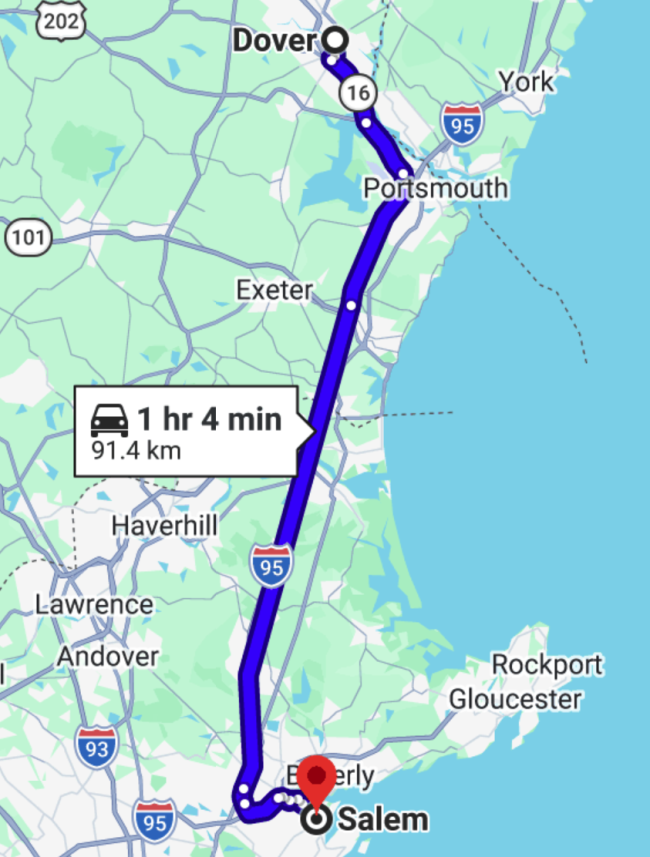
We drove over to Colleen’s home, and she drove us to Salem (the spooky place).
Salem, Massachusetts, is a historic coastal city north of Boston, best known for the Salem Witch Trials of 1692, when fear and accusations led to the execution of 20 people. Today, Salem is a popular tourist destination with museums, historic homes, waterfront areas, and a strong focus on Halloween and witch-trial history.
Salem also has an important maritime past, once serving as a major trading port in early America. Key attractions include the Salem Witch Museum, The House of the Seven Gables, Peabody Essex Museum, and historic downtown Salem.
From the fourth floor of the parking structure, I captured the local church, one of many!! I now know why they call this “The Granite State”.
We headed to the Salem Witch Trial Museum. The Salem Witch Museum in Salem, Massachusetts, explains the history of the 1692 Salem Witch Trials, when fear, superstition, and accusations led to the imprisonment and execution of innocent people.
The museum’s main exhibit uses dramatic narration, lighting, and life-sized figures to tell the story of the trials. It also features an exhibit on how ideas about “witches” have changed over time, highlighting connections to stereotypes, fear, and scapegoating.
Overall, the museum presents the witch trials as a warning about mass hysteria, injustice, and the dangers of accusing others without evidence.
After a short wait, we headed inside through the gift store.
Inside the theater, a narrator explained many displays.
The Salem Witch Trials started in 1692 in Salem Village, Massachusetts, when several young girls began having strange fits—screaming, contorting their bodies, and claiming they were being harmed by invisible forces.
The first girls involved were Betty Parris and Abigail Williams, who lived in the household of the local minister, Samuel Parris. When doctors could not explain their symptoms, some people concluded they were victims of witchcraft.
Under pressure, the girls accused several people of bewitching them, including:
Tituba, an enslaved woman in the Parris household
Sarah Good, a poor woman
Sarah Osborne, an older woman involved in local disputes
These accusations spread quickly because Salem was already full of religious fear, local conflicts, political tension, disease, war anxiety, and suspicion of outsiders. Once the legal authorities accepted “spectral evidence”—claims that a person’s spirit had attacked someone—the accusations grew into a much larger panic.
They were on trial until they were found guilty.
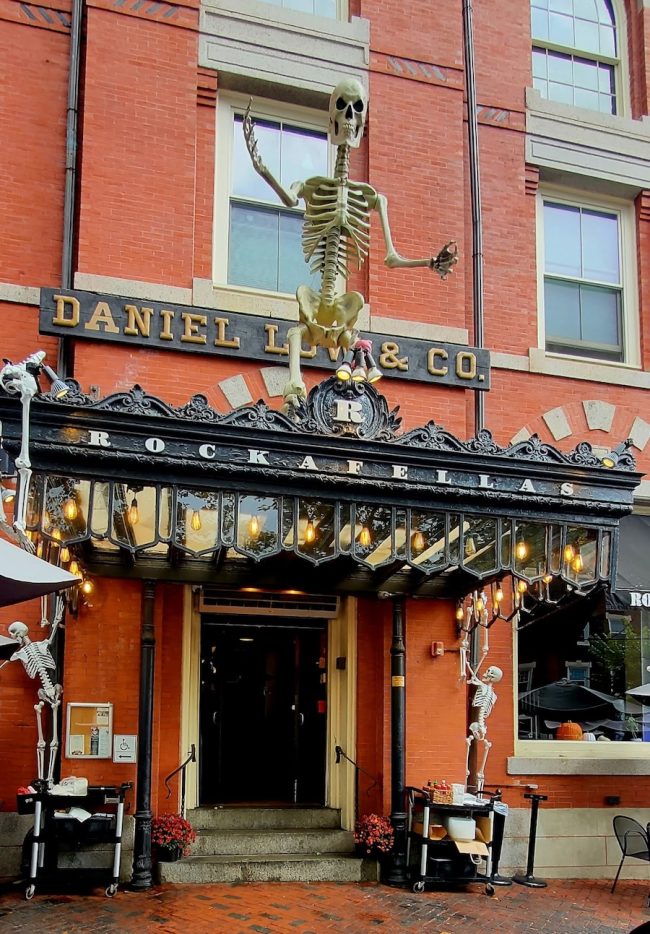
We departed the museum and headed to lunch at Rockafellas. On the way, we stopped at several gift stores.
Terrance Marchino, Kevin Marchino, and David McKillop founded Rockafellas, which opened in the famous Daniel Low Building in 2003. Their outdoor café can host up to 240 guests during the warmer months.
Members of Salem’s First Church laid the Daniel Low Building cornerstone on April 27, 1826. Beneath the cornerstone, members of Salem’s First Church deposited a silver plate bearing the names of the congregation’s past and current ministers. Silver remained an important part of the building’s history.
From the beginning, the church used the building’s second floor for worship and rented the ground floor to various commercial ventures to help pay for construction and maintenance. Tenants included a crockery, glass, and china shop owned by William Bowditch, a dry goods store owned by Edwin Ide, and a ladies’ furnishing store owned by John P. Peabody. In the 1860s and 1870s, the National Exchange Bank was the tenant, adding the vault and double-depth windows, features still in place today.
In 1867, Daniel Low opened his jewelry business in a corner room, but soon took over the entire first floor. Low started the mail-order business in 1892 after his company began manufacturing and selling a silver souvenir witch spoon and advertised it in many national publications. The response to that item prompted him to create one of the first mail-order catalogs. Low died in 1911 and was succeeded by his son Seth, who ran the business until he died in 1939, and by Seth’s widow, Florence, until the mid-1950s. Created a grand staircase between the first and second floors, which has since been demolished.
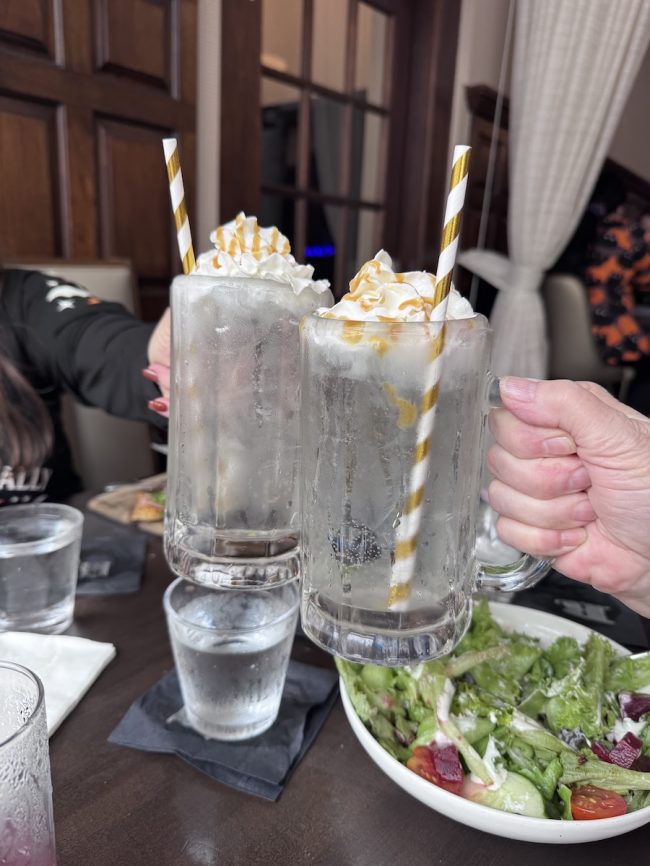
Inside, we had several Halloween drinks. We staggered back to the car (Colleen was the DD, so she didn’t drink anything).
Their food was excellent, and the waitress was very funny!
The drinks were interesting but lacked any serious alcohol.
We enjoyed sharing the Halloween drinks!!
Colleen and Robin kept the conversation funny. They are good girls!!!
Never a dull moment!!
We loved the ceiling decorations!
I loved the “Butterbeer”!!
Swirling it up makes it look different!
After our drinks, we hopped back towards the car and stopped several more times to take pictures and visit shops!
Mary kept frightening the ghouls.
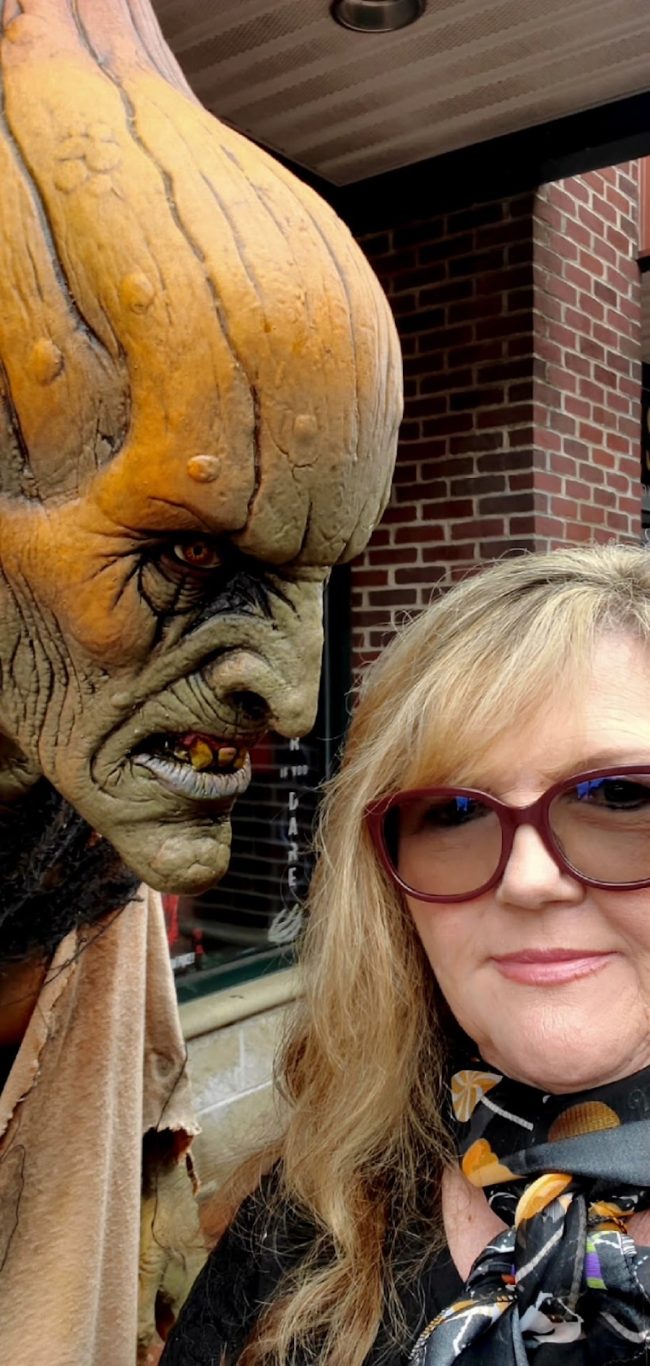
We enjoyed seeing people in costume well before October 31st. Salem is an interesting town!!
The street was fenced off from traffic because a large parade is planned tomorrow. Mary liked talking to the spooks along the way!
We headed home and passed many old homes dating back hundreds of years.
We stopped at Colleen’s home and picked up our car while Colleen took Robin to urgent care for a rash on her hands.
Mary and I went to the inn and had some wine and a cup of tea before heading upstairs
We began the day fairly early, as we have an hour-long drive into Boston from here. Mary and I had breakfast at the inn while Robin packed up and transferred rooms from the third (scary) floor to the more mundane second floor.
Pancakes and a scone! I am ready to go!
We drove for an hour, and Mother Nature was kind: no rain, just grey skies and the threat of more moisture.
It was a pleasant drive with little traffic until we got into town.
Our first stop was Paul Revere’s Home, and we parked underneath the Boston Common and walked the rest of the way. Boston Common is a historic public park in downtown Boston, Massachusetts. Established in 1634, it is the oldest public park in the United States. Originally used for grazing cattle, military training, and public gatherings, it later became an important site for protests, celebrations, and civic events.
Today, Boston Common is part of the Emerald Necklace park system and connects to the Boston Public Garden. It features walking paths, monuments, open lawns, the Frog Pond, and access to the Freedom Trail. It remains a popular place for locals and visitors to relax, explore history, and enjoy outdoor events.
Robin spotted the first sign for Paul Revere’s house, and we headed in that direction. It was only two blocks away!
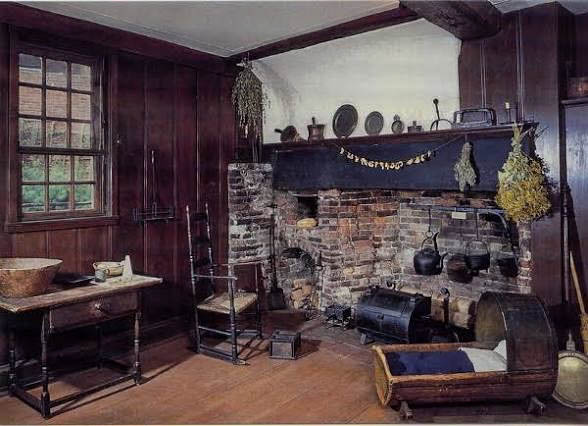
His house was in great shape for being 300 years old. Paul Revere’s home, known as the Paul Revere House, is a historic house in Boston’s North End. Built around 1680, it is the oldest remaining building in downtown Boston. Paul Revere, the famous patriot and silversmith, lived there with his family from 1770 to 1800.
The house is best known for its connection to Revere’s role in the American Revolution, especially his famous midnight ride in 1775 to warn colonial leaders that British troops were moving. Today, the house is a museum that showcases what colonial life was like and features period furniture, exhibits on Revere’s work, and information about his family and revolutionary activities.
ScreenshotClick an individual image to view it at full size.
Here is “Paul Revere’s Ride” by Henry Wadsworth Longfellow:
Paul Revere’s Ride
Listen, my children, and you shall hear Of the midnight ride of Paul Revere, On the eighteenth of April, in Seventy-Five: Hardly a man is now alive Who remembers that famous day and year.
He said to his friend, “If the British march By land or sea from the town to-night, Hang a lantern aloft in the belfry arch Of the North Church tower as a signal light,— One, if by land, and two, if by sea; And I on the opposite shore will be, Ready to ride and spread the alarm Through every Middlesex village and farm, For the country folk to be up and to arm.”
Then he said “Good-night!” and with muffled oar Silently rowed to the Charlestown shore, Just as the moon rose over the bay, Where swinging wide at her moorings lay The Somerset, British man-of-war; A phantom ship, with each mast and spar Across the moon like a prison bar, And a huge black hulk, that was magnified By its own reflection in the tide.
Meanwhile, his friend, through alley and street, Wanders and watches, with eager ears, Till in the silence around him he hears The muster of men at the barrack door, The sound of arms, and the tramp of feet, And the measured tread of the grenadiers Marching down to their boats on the shore.
Then he climbed the tower of the Old North Church, By the wooden stairs, with stealthy tread, To the belfry-chamber overhead, And startled the pigeons from their perch On the sombre rafters, that round him made Masses and moving shapes of shade,— By the trembling ladder, steep and tall, To the highest window in the wall, Where he paused to listen and look down A moment on the roofs of the town, And the moonlight flowing over all.
Beneath, in the churchyard, lay the dead, In their night-encampment on the hill, Wrapped in silence so deep and still That he could hear, like a sentinel’s tread, The watchful night-wind, as it went Creeping along from tent to tent, And seeming to whisper, “All is well!” A moment only he feels the spell Of the place and the hour, and the secret dread Of the lonely belfry and the dead; For suddenly all his thoughts are bent On a shadowy something far away, Where the river widens to meet the bay,— A line of black that bends and floats On the rising tide, like a bridge of boats.
Meanwhile, impatient to mount and ride, Booted and spurred, with a heavy stride On the opposite shore walked Paul Revere. Now he patted his horse’s side, Now gazed at the landscape far and near, Then, impetuous, stamped the earth, And turned and tightened his saddle-girth; But mostly he watched with eager search The belfry-tower of the Old North Church, As it rose above the graves on the hill, Lonely and spectral and sombre and still. And lo! as he looks, on the belfry’s height, A glimmer, and then a gleam of light! He springs to the saddle, the bridle he turns, But lingers and gazes, till full on his sight A second lamp in the belfry burns!
A hurry of hoofs in a village street, A shape in the moonlight, a bulk in the dark, And beneath, from the pebbles, in passing, a spark Struck out by a steed flying fearless and fleet: That was all! And yet, through the gloom and the light, The fate of a nation was riding that night; And the spark struck out by that steed, in his flight, Kindled the land into flame with its heat.
He has left the village and mounted the steep, And beneath him, tranquil and broad and deep, Is the Mystic, meeting the ocean tides; And under the alders, that skirt its edge, Now soft on the sand, now loud on the ledge, Is heard the tramp of his steed as he rides.
It was twelve by the village clock When he crossed the bridge into Medford town. He heard the crowing of the cock, And the barking of the farmer’s dog, And felt the damp of the river fog, That rises after the sun goes down.
It was one by the village clock, When he galloped into Lexington. He saw the gilded weathercock Swim in the moonlight as he passed, And the meeting-house windows, blank and bare, Gaze at him with a spectral glare, As if they already stood aghast At the bloody work they would look upon.
It was two by the village clock, When he came to the bridge in Concord town. He heard the bleating of the flock, And the twitter of birds among the trees, And felt the breath of the morning breeze Blowing over the meadows brown. And one was safe and asleep in his bed Who at the bridge would be first to fall, Who that day would be lying dead, Pierced by a British musket-ball.
You know the rest. In the books you have read How the British Regulars fired and fled,— How the farmers gave them ball for ball, From behind each fence and farmyard-wall, Chasing the red-coats down the lane, Then crossing the fields to emerge again Under the trees at the turn of the road, And only pausing to fire and load.
So through the night rode Paul Revere; And so through the night went his cry of alarm To every Middlesex village and farm,— A cry of defiance, and not of fear, A voice in the darkness, a knock at the door, And a word that shall echo forevermore! For, borne on the night-wind of the Past, Through all our history, to the last, In the hour of darkness and peril and need, The people will waken and listen to hear The hurrying hoof-beats of that steed, And the midnight message of Paul Revere.
We walked through the house, and it was hard to imagine what it must have been like 300 years ago.
Remember, this newspaper article is 120 years old today!
Each room was small and unique. Every room had a fireplace or something to keep people warm. The people were about two inches shorter than they are today. Everything was handmade; no IKEA here!
Out image was captured by a friendly spirit.
On our way back to the car, the girls found Nirvana, so we stopped. They ran across the street, and I perched myself on a narrow seat and ate!!
We made it to the car, drove off to Cheers, and found a parking place nearby. We thought for sure that it would be crowded, but we got in with no wait!!
We spotted the Cheers Flag, went downstairs, and stepped back in time.
The actual bar in Boston was originally named the Bull & Finch Pub (located at 84 Beacon Street). Its exterior was used in the show’s opening credits and transition scenes, but virtually all interior scenes with the cast were filmed on a soundstage at Paramount Studios in Los Angeles, in front of a live studio audience. The interior layout of the real Boston pub looks completely different from the famous television set, though it later added a partial replica set upstairs for visitors.
I expected the food to be average but was pleasantly surprised to find the meal first-class. We all enjoyed our selections, and I especially enjoyed the drinks!
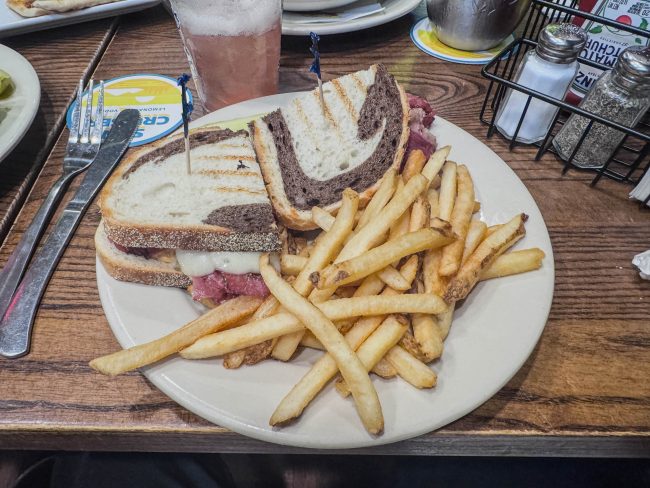
The pastrami-reuben was outstanding!!!
We laughed and giggled and told stories the entire time.
We made our way back to the car, headed north to Colleen’s home, and then departed for The Silver Fountain to get two hours’ rest before the party started again.
Colleen and Mark picked us up at the inn at 5:45 pm, and we went to dinner.
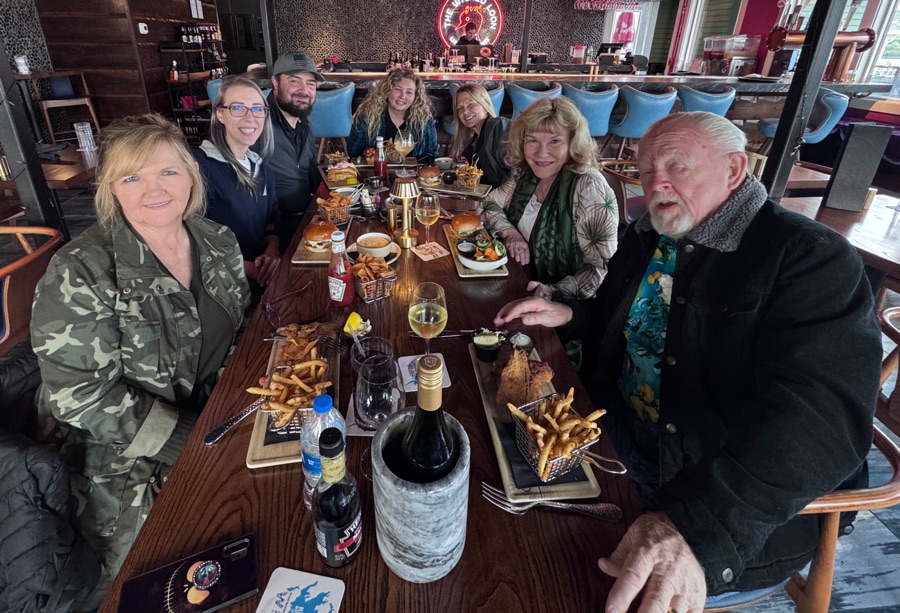
We dined and jabbered for almost two hours!!
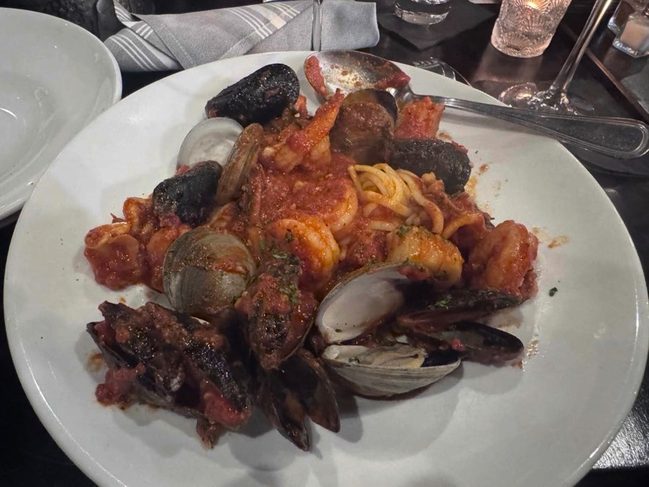
I went for the fruit off the sea! It was perfect, and it contained a load of fruit!!!
Jon was having a great time talking about eating Bambi!
From dinner, it was only a few blocks to our inn, so we were dropped off and immediately headed for the sack. Sightseeing is an arduous task, especially for old people!
We were up early and had breakfast at the inn. After devouring our breakfast, we headed to Colleen’s house and met up with Colleen and Cassie. As an added surprise, both Jon and Sarah joined us for the day!
We departed Dover for the Wright Museum of WWII at 77 Center St, Wolfeboro, NH 03894. The drive was a bit wet, but the colors made up for the moisture.
After 45 minutes,s we arrived at the museum and made a complete tour. In 1994, the Wright Museum of World War II opened in Wolfeboro, New Hampshire, a creation of its visionary founder, the late David Wright. For thirty years and counting, this educational institution has fulfilled David’s dream of fostering public understanding and appreciation of the exceptional contributions made by World War II-era Americans on the home front and on the battlefields.
Their vision is to be the preeminent history museum that preserves and promotes a comprehensive understanding and appreciation of the enduring contributions made by World War II-era Americans.
Come on in!!!
We were introduced to the museum by its docents.
We are ready to enter and be amazed!!!
They had a room devoted to recreating “Life In The 1940s,” including the soda fountain!
The soda fountain was a recreation of the 1940s.
The displays were first-class! Jon had fun looking at the post office and its PO Boxes.
The museum recreated many scenes from the 1940s, including the ice cream parlor, a typical living room, a repair shop, and a pharmacy!
People are clever! They turned the model-T into a ski machine!
Model Ts were converted to snowmobiles!!
The Timeline walkthrough showed the highlights of every year from 1939 through 1945, the period of WWII. Each room had data and pictures from that decade.
Follow me!!!
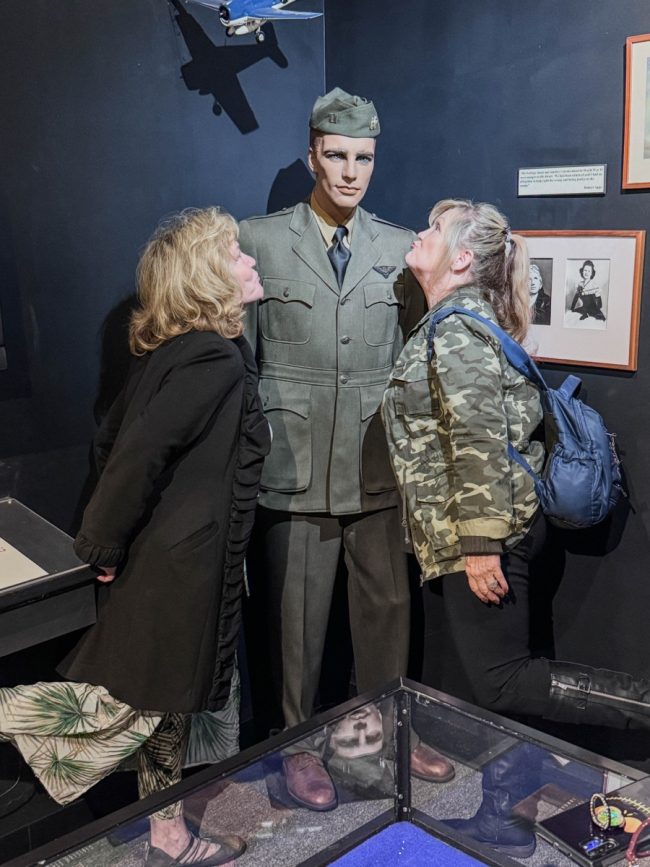
The girls always fall for the boys in uniform!
He does not have a chance!!
The museum was a lumber yard, and when it was converted into a museum, they used the high bay to store and display cars, trucks, tanks, and airplanes.
Click on the individual images to see the full-size image
The tanks can be driven around today; everything is in running condition.
From the museum, we went to lunch at the Wicked Lune. Lunch was a riot, with oysters flying all over the place.
Screenshot
Click on the individual images to see the full-size image
After lunch, we were off to the candy store named Lickee’s and Chewy’s, where everyone went wild! Lickee’s & Chewy’s Candies & Creamery is a one-of-a-kind, award-winning, medieval-themed candy store, chocolate factory & ice cream/dessert restaurant featuring nearly 5,000 sq ft of candies and chocolates from around the world, housed in a 200-year-old mill in downtown Dover, New Hampshire.
The store is named after Lickee, the knight, and Chewy, the dragon from the Kingdom of Caramelot, and is home to the giant Kingshake, an extra-large, themed ice cream shake loaded with special toppings, built for a King or Queen. Our ice cream and dessert choices also include 28 flavors of locally made ice cream and sorbet, custom shakes, sundaes, chocolate-covered ice cream sandwiches, soft serve with handmade chocolate dips, shaved ice, French macarons, cheesecakes, and more.
They have one of the largest candy selections in New England with over 200 bulk candies, gummies, and Jelly Belly jelly beans; imported British and European chocolates, high-quality non-GMO, gluten-free Swedish gummies made with real sugar, Japanese sweets, Harry Potter candies, classic nostalgic candies, British/French and German hard candies, 100s of PEZ, and much, much more.
Lickee’s & Chewy’s also produces numerous handmade chocolates, caramels, truffles, chocolate bars, peanut butter cups, toffees, fudge, specialty cookies, stroopwafels, and our famous caramel apples (made only with handpicked honey-crisp apples covered in our handmade caramel)
Click on the individual images to see the full-size image
We had ice cream for dessert and then headed to Colleen’s house to pick up our car and go home for the evening. Everyone was tired!
Once we returned to the hotel, we had tea and crashed around 8:00 pm. It has been a good day!!
Mary planned to head to school early for what was apparently a very important fancy breakfast with her classmates. Meanwhile, Robin and I planned to stay behind to handle the glamorous behind-the-scenes work: packing everything up, eating breakfast, and cramming our belongings into the car. Basically, ten pounds of bags in a five-pound car. We challenged the laws of physics.
Mary was off and running at 7:00 a.m., bright-eyed and breakfast-bound, while we stayed back to finish packing our traveling circus. Of course, breakfast was mandatory — we needed to fuel up for the next four hours of driving, navigating, and pretending the car wasn’t completely stuffed to the roof. pound car. Physics was not on our side.
I checked the weather reports, and it looks like we’ll miss the storm — but only by the kind of tiny margin that makes you question your life choices. We’ll get some rain on the way to Dover, but thankfully it should be mostly light, with mild winds and, hopefully, no dramatic, movie-style windshield moments.
My French Toast was almost too pretty to eat!
Robin was all perky this morning after another good night’s sleep, including napping by the fireplace in the lobby late last night.
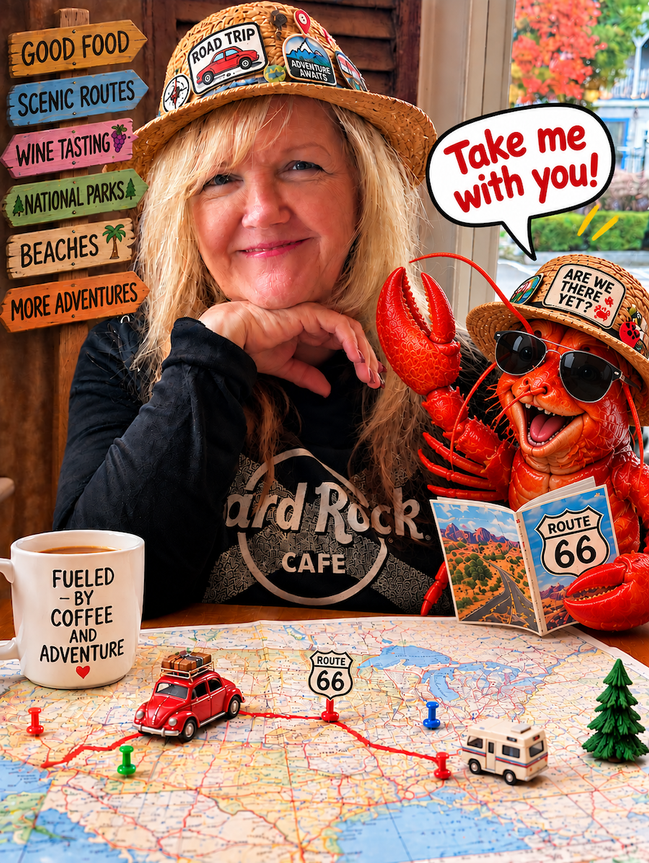
Just before we got up to leave, Robin’s new best friend came to the table to review today’s plans. While I do not speak fluent lobster, I think he wanted to go with us!
It was OK with me, but he must share the driving on the way to Colleen’s home!
After breakfast, we returned to the room with a suitcase caddy because we had so many bags.
The trip was four hours long, half of which was in OK weather and the other half in a rainstorm.
We got to Colleen’s place around 4:45 pm, and then all the grandkids showed up with their favorite pizzas. We spent two hours catching up before heading to The Silver Fountain Inn, just two miles from Colleen’s home.
We arrived on time. The kids are on h their favorite pizzas. Colleen was happy to see us.
Colleen and Mary have become great friends!
The kids started arriving, and dinner was getting ready! We had a plethora of food, and the pizzas ranged from cheese to jalapeño! Jon (our grandson) and Sarah (his bride) were busy in the kitchen!
Meanwhile, Mary was visiting everyone. There was so much action that I forgot to take many pictures!!
Before going to our inn and getting some well-deserved rest, we did a group picture (courtesy of Mark.
Quite a gaggle. Two kids, three grandkids, four great-grandkids! We keep getting larger!
We went to the inn, thanks to Mark and Jon, who hefted the suitcases up the steep staircase.
We were up early so we could have breakfast with the schoolgirl, but alas, Mary wanted to make a good impression and went to school early (…and she has a highly polished apple in her possession)
Robin and I had breakfast before our tour began. We ate at the hotel since that is where we’re getting picked up.
I went for the salmon, bagels, and cream cheese!
Robin and I selected a private tour this morning. There were only four people today, so we had all the room we needed! The driver/guide was outstanding.
Our chariot awaits
Off we went in a cloud of dust! The first stop was Acadia National Park, which is the smallest but most visited national park!
Location: Mostly on Mount Desert Island along the Atlantic coast.
Known for: Rocky beaches, forests, mountains, lakes, and ocean views.
Famous spot: Cadillac Mountain, one of the first places in the U.S. to see the sunrise.
Activities: Hiking, biking, camping, birdwatching, kayaking, and scenic driving.
Wildlife: Deer, foxes, seals, seabirds, and many other animals.
Popular road: The Park Loop Road, which takes visitors past many major sights.
Best time to visit: Summer and fall, especially when the leaves change color.
In short, Acadia National Park is known for its dramatic coastline, mountain views, and outdoor activities.
We got bearings here!
We meandered through a small portion of an area made to represent the remaining part of Acadia.
We could see fish in the pond!
We continued walking for about 30 minutes, and the displays of plants and flowers were amazing. The signage was excellent, easy to read and quite complete.
We could see fish in the pond!
From the reserve/preserve, we traveled to Thunder Hole, which is a famous shoreline feature in Acadia National Park on Mount Desert Island, Maine.
It’s a small inlet carved into the rocky coast where incoming waves rush into a narrow channel and partially submerged cave. When conditions are right, trapped air and water are forced out with a loud booming “thunder” sound, and spray can shoot high into the air.
A few useful things to know:
Location: Along the Park Loop Road, between Sand Beach and Otter Cliff.
Best time to visit: Often 1–2 hours before high tide, especially when the surf is strong.
Safety: It can be dangerous during rough seas. Stay behind railings and off wet rocks—unexpected waves can sweep people off their feet.
Experience varies: Sometimes it roars dramatically; other times it may just gurgle if the tide and waves aren’t right.
Nearby sights: Sand Beach, Ocean Path, Monument Cove, and Otter Cliff are close by.
It’s one of Acadia’s classic stops because it combines dramatic ocean views, rugged granite coastline, and a bit of natural sound effects. Robin went all the way down, but I was favoring my leg, so I sat at the top watching people.
It did sound like thunder!!
Thunder Hole often gets closed because the high waves hit the shore and make everything wet, including the various stairways to/from the actual rock formation.
The sign was not kiddingIt was a long walk to the hole!
From Thunder Hole, we went to Beaver Lake and got out to stretch our legs. Because of the upcoming storm, it was quite windy! The beavers were nearly hunted to extinction in this area, but Rockefellow and friends brought them back.
Hike time!
The next stop was short but refreshing.
The wind was almost gale-force, so we did NOT go to the water.
We found a nice park bench, and Robin decided to go into business.
No takers???
Then we went to the mountain, Cadillac Mountain, to be precise! It was 2,700 feet tall and the highest point on the East Coast!
Cadillac Mountain is one of the most famous places in Acadia National Park, Maine.
It is the highest point on the U.S. Atlantic coast, rising about 1,530 feet(466 meters) above sea level. From the top, you get wide views of Bar Harbor, the Porcupine Islands, Frenchman Bay, and the surrounding mountains and coastline.
Famous for sunrise: Cadillac Mountain is known as one of the first places in the U.S. to see sunrise during parts of the year.
Summit road: You can drive to the top on Cadillac Summit Road, but in busy seasons you usually need a vehicle reservation.
Hiking: Popular trails to the summit include the North Ridge Trail and South Ridge Trail.
Views: The summit has short walking paths with excellent panoramic views.
Weather: It can be windy and much colder at the top than in Bar Harbor, so bring a jacket.
It’s one of the must-see spots in Acadia, especially if you like sunrise, photography, or scenic mountain views.
Bar Harbor was directly to the east of us.
Now, it was time for lunch, and we stopped at a small restaurant. I had their chicken sandwich, and I got a glass of vino.
Lunchtime!
From there, we returned toBar Harbor and rested, awaiting the arrival of Dr. Mary. She got out of class at 2:15 pm. Robin got cleaned up, and we headed for Lobster Ice Cream.
Lobster ice cream is a real novelty dessert, most famously associated with Maine, especially around coastal tourist areas.
It’s usually made with:
A butter-flavored or vanilla ice cream base
Small pieces of cooked lobster meat
Sometimes a hint of salt or extra butter flavor
The taste is unusual: creamy, slightly sweet, buttery, and a little seafood-like. Some people love it as a fun Maine experience, while others try it mostly for the novelty.
It’s not a common everyday flavor, but you may find it at specialty ice cream shops in Maine, especially near places like Bar Harbor or other coastal towns.
We strolled down the street looking at all the goodies and taking pictures in the park
Just us!
The fall colors are coming on strong, and things change daily!
Color changes rapidly!
A leaf usually takes a few days to a couple of weeks to change from green to orange, depending on the tree species and weather.
Cool nights and sunny days speed up color change.
Shorter daylight hours trigger the process in autumn.
Drought, frost, or stress can make leaves change faster or turn brown instead.
Some trees change gradually over 1–3 weeks, while individual leaves may change noticeably in just a few days.
The orange color appears as the green chlorophyll breaks down and pigments called carotenoids become visible.
It was 4:30 pm when we stopped at Patty’s for a drink!
We headed to the hotel as we were all pooped out, and the rain was supposed to start in about an hour.
Robin caught us just before we entered the hotel for the evening.
We crashed EARLY, and tomorrow we pack up and leave for New Hampshire.
We slept like it was out of style. Robin, who is usually up and moving at 3:00 am, was called at 10:00 am, and she was still asleep. This traveling takes a lot out of you!! So Mary and I went downstairs to the dining room and had a wonderful breakfast!
We enjoyed breakfast while watching the boats go back and forth. Perhaps they are getting ready for the big storm coming our way!
We had a spectacular view of the bay
Mary dove into her breakfast like there was no tomorrow and even took some of my bagel!
Breakfast is served
After breakfast, Mary headed to school while the old man (me) got ready to go out with Robin (the sleephead). We walked down the street a spell and ran into a very nice restaurant. It looked like a hole in the wall from the street, but the inside was huge and quite modern.
Clams and lobster, her specialty
While Robin was munching on fish, I decided to have a nice salad… in fact, I ordered two vertical salads!
The two-fisted drinker (I ate the salad first!!)
After my salads, I had crab-and-lobster-stuffed mushroom caps! Delicious! Robin and I took off for a four-hour walk through “town”. Robin visited every store and kept the economy running. She looked like she was shopping for Christmas. During our long walk, I stopped at a pharmacy and picked up some additional allergy medication.
The town is 235 years old!
I kept track of the incoming storm, and now it is scheduled to hit tomorrow evening around dinner time.
Noreaster heading this way!
A nor’easter gets its name from the strong winds that blow from the northeast over the coastal area. These storms happen most often and are most violent between September and April.
At 4:00 pm, we headed back to the hotel and meeting hall to pick up Mary for dinner, eager to hear all about what she learned in school today—because apparently we were now the proud parents of a fully grown conference attendee.
Silly me, I misread my watch and got us to the conference center an entire hour early. Nothing says “seasoned traveler” like arriving with the confidence of a Swiss train and the accuracy of a broken sundial.
Since the conference center was approximately the size of a regional airport, Robin decided to walk the premises and get her steps in. Meanwhile, I took up residence in the lobby, where I sat politely looking at and listening to presentations I was not technically attending. Within minutes, I had the facial expression of someone deeply engaged, while understanding just enough to nod at the appropriate moments and pretend I belonged there.
Off to pick up Mary after school
Since Mary skipped out without us, we went back to the hotel, just two “doors” down the way, and met up with Mary for a drink before dinner!
On my way to the bar, I met “Bark, TheWonderr Dog”. He is a Pyrenees, and he was so friendly I had to sit and talk to him for a few minutes!
The Great Pyrenees is a large, fluffy livestock guardian dog originally bred in the Pyrenees Mountains between France and Spain.
Key facts:
Size: Very large; males often weigh 100+ lb / 45+ kg.
Coat: Thick white double coat, sometimes with gray, tan, or badger markings.
Temperament: Calm, loyal, gentle, protective, and independent.
Original job: Guarding sheep from wolves, bears, and other predators.
Family life: Usually affectionate and patient, often good with children.
Training: Needs early socialization and consistent training because they can be stubborn.
Exercise: Moderate daily exercise, not usually hyperactive.
Barking: They often bark a lot, especially at night, because guarding is their instinct.
Grooming: Heavy shedding; regular brushing is needed.
Best for: Homes with space, secure fencing, and owners who understand guardian breeds.
In short: the Great Pyrenees is a gentle giant—sweet with family, but naturally protective and independent.
We went to the bar and had a bottle of Chardonnay between the three of us. We also struck up a conversation with the barkeep and the pizza maker! We sent them the AI results; everyone got a giggle or two from the photos.
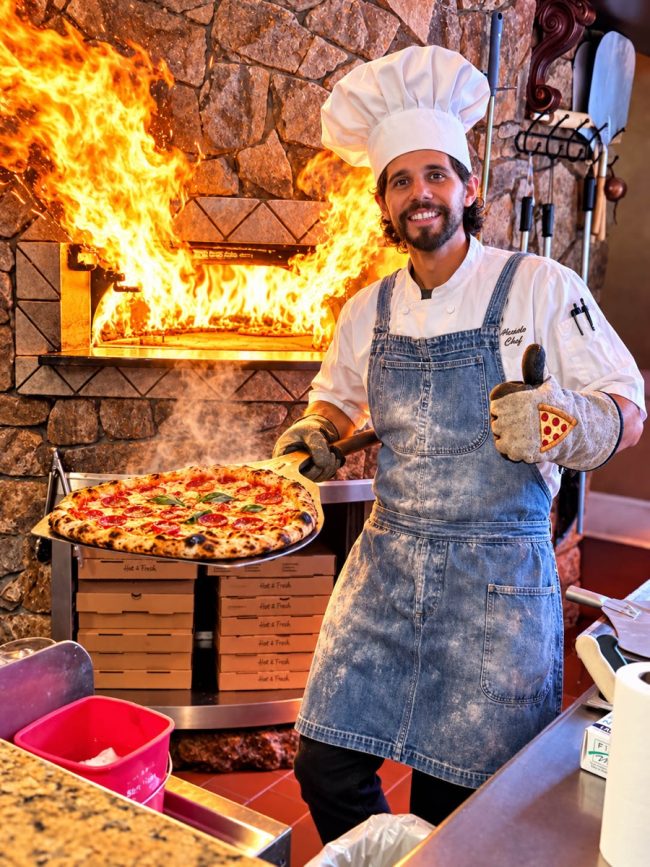
Our pizza chef was good to talk to.The bartender was quite funny.
We drank our wine slowly before making our way back to the conference center for the lobster bake!
Always happy!One small drink before dinner.
Off to the clam bake! They had excellent corn, pots loaded with veggies, and three or four LARGE pots with whole lobsters waiting for us!
I named him “Red”
Lobsters are marine crustaceans known for their hard shells, large claws, and long antennae.
Habitat: They live on the ocean floor, often hiding in rocks, reefs, or burrows.
Diet: Lobsters are omnivores; they eat fish, mollusks, worms, algae, and sometimes dead animals.
Body: They have a hard exoskeleton, which they must shed as they grow.
Molting: When a lobster molts, its new shell is soft, making it vulnerable until it hardens.
Claws: Many lobsters have two different claws: one for crushing and one for cutting.
Lifespan: Some lobsters can live for several decades.
Color: Live lobsters are usually dark greenish-brown, blue, or reddish; they turn bright red when cooked.
Defense: They use claws, antennae, and quick tail flips to escape predators.
Reproduction: Female lobsters carry eggs under their tails until they hatch.
Human use: Lobsters are considered a valuable seafood in many parts of the world.
In short: lobsters are tough, bottom-dwelling sea animals with strong claws, long lives, and a unique growth process through molting.
Using my culinary skills, I prepared three lobsters, one for each of us. A waiter came by and offered to show us how to do it without using a knife and fork. Robin and I enjoyed a second lobster, and I even had a third one for good measure.
Here you go, ma’am!
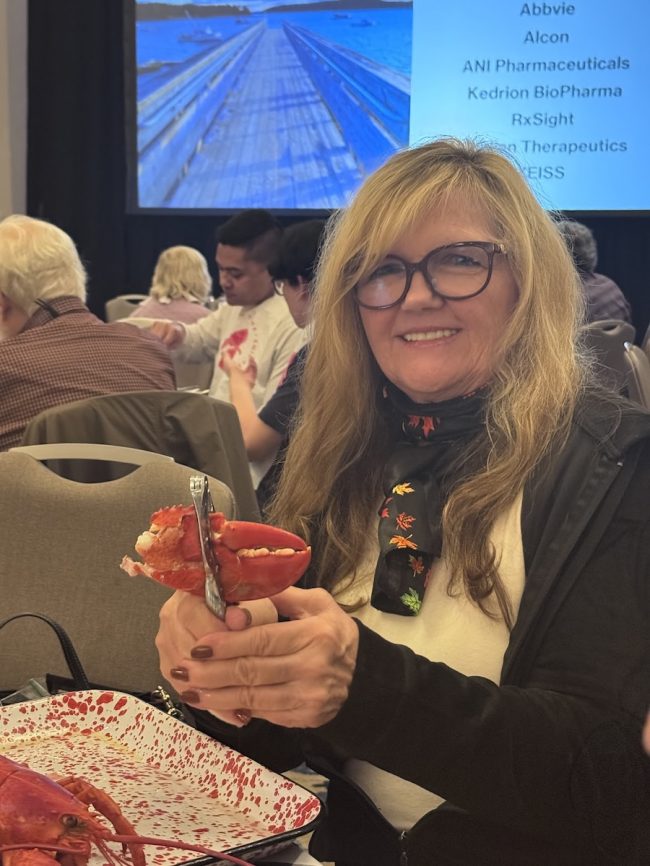
It’s everything it is cracked up to be!!!
The girls really go all in on this lobster bake idea!
Bye-bye lobsterMunch munch
I was full to the brim.
Red is trying to talk, but I do not speak lobster very well!!
We walked back to the hotel and decided we were a) full and b) tired, so we hit the hay! It was a long but interesting day!